2026-11-10
Eyereum Eye Clinic's Dr. Kang Sung-yong Presents New Centration Strategy for SMILE and SMART NOVA Refractive Surgery at ARVO 2026
Eyereum Eye Clinic's Dr. Kang Sung-yong co-authored an ARVO 2026 study on an asymmetric transition zone centration strategy for SMILE refractive surgery.
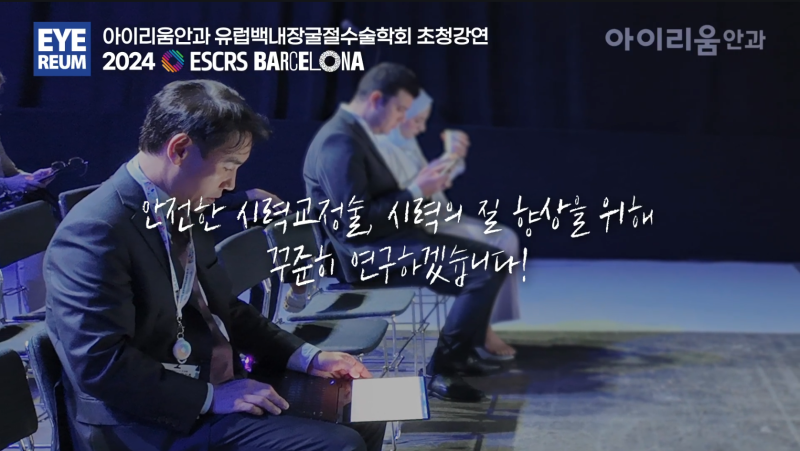
Enhancing the precision of SMILE and SMART NOVA vision correction
A study on a new centration strategy

▶ Conference: ARVO 2026 Annual Meeting
▶ Published in: IOVS 2026 ARVO Abstracts Issue
▶ Title: New Asymmetric Transition Zone Centration Strategy for Refractive Corrections: Theoretical Background and Preliminary Clinical Results
▶ Authors: Shwetabh Verma, David Sung Yong Kang (Dr. Kang Sung-yong), Ivan Gabric, Victor Derhartunian, Samuel Arba Mosquera
Vision correction surgery is not just about correcting nearsightedness and astigmatism.
Equally important is determining where the laser is precisely aimed on the eye, in other words, how the center of the procedure is defined.
In many people, the center of the pupil and the center of the cornea do not fully align, and subtle shifts in gaze or eye rotation can occur during surgery.
How these differences are taken into account when designing the procedure can be highly significant in precision refractive surgery.
Research on this topic was presented at ARVO 2026 (Association for Research in Vision and Ophthalmology), the world's largest ophthalmology conference.
Dr. Kang Sung-yong of Eyereum Eye Clinic participated as a co-author of this study, and the research abstract was published in the June 2026 ARVO Abstracts Issue of IOVS (Investigative Ophthalmology & Visual Science).

ARVO: A Global Conference in Eye Research
ARVO is a leading international conference in ophthalmology and vision science. Eye care specialists and researchers from around the world gather to present and share the latest research findings, including new diagnostic and treatment technologies and clinical study results.
IOVS (Investigative Ophthalmology & Visual Science), the journal that published this study's abstract, is also one of the leading SCI-indexed international journals in ophthalmology and vision science.

A New Strategy for Fine-Tuning the “Surgical Center,” the Core of Vision Correction
This study introduces a new centration strategy (aTZ, asymmetric Transition Zone) that accounts for subtle differences in centration and eye rotation that can occur in keratorefractive lenticule extraction (KLEx) procedures such as SMILE.
Put simply, it is a method that keeps the central zone responsible for vision precisely in place while flexibly designing the peripheral zone to match differences in each patient's eye position.
Conventional approaches typically connect the central and peripheral zones symmetrically. In contrast, this study designs the peripheral zone asymmetrically to reflect eye position differences identified during surgery. This suggests a new possibility of compensating for decentration while preserving the optical quality of the central zone.
In addition, the correction depth in the central zone and the amount of corneal tissue removed were found to remain similar to conventional methods. The study is meaningful because it presents the theoretical background and preliminary clinical results suggesting that more precise centration may be achievable while maintaining central optical quality.
Why Is This Study Important?
The significance of this study lies in its approach. Rather than viewing vision correction merely as a procedure to correct nearsightedness and astigmatism, it considers each patient's eye structure, centration, and gaze characteristics as part of precision refractive surgery.
Corneal thickness, the degree of nearsightedness and astigmatism, pupil size, and corneal shape have long been important examination factors.
On top of these, this study points toward more precise surgical planning by also considering the actual eye position during surgery, centration differences, and eye rotation.
Back in 2019, Dr. Kang Sung-yong proposed “SMILE Triple Centration,” a technique for accurate centering on the corneal apex during SMILE surgery. He also published an SCI paper on the effects of improving higher-order aberrations, which are a cause of optical side effects such as nighttime halos and glare.
SMART NOVA with CenTrax® Automatic Centration Technology

SMART NOVA, performed at Eyereum Eye Clinic, uses CenTrax technology, which allows the lenticule's centration position to be objectively verified and corrected during surgery.
The centration strategy presented in this study aligns with this concept of precise centration and shows potential to improve the precision of lenticule-based refractive surgery in the future.

However, this strategy does not apply equally to every patient.
After a detailed examination of corneal condition, the degree of nearsightedness and astigmatism, pupil size, eye structure, and gaze characteristics, the medical team determines on a case-by-case basis whether the strategy is appropriate.
Vision correction surgery requires evidence.
Vision correction continues to advance, but not every new technology necessarily leads to better results.
What matters is verifying safety and precision through objective research and clinical data.

Gangnam Eye Clinic and Eyereum Eye Clinic continue to take part in international academic research to build this kind of evidence.
This ARVO 2026 presentation is one part of our research toward more precise vision correction. We will continue to provide evidence-based care that truly helps our patients.


Frequently Asked Questions
What did this ARVO 2026 study cover?
This study introduced a new centration strategy (aTZ) for KLEx-based vision correction procedures, such as SMILE, that takes into account differences in eye centration and eye rotation. The method keeps the central zone precise while flexibly designing the peripheral zone to match each patient's eye position.
How does the asymmetric transition zone centration strategy work?
This strategy designs the peripheral zone asymmetrically to match the eye position differences identified during surgery. Unlike conventional methods that connect the central and peripheral zones symmetrically, it suggests a way to compensate for decentration while maintaining the optical quality of the central zone.
Does this strategy apply to all patients?
No, it does not apply equally to all patients. After a detailed examination of corneal condition, the degree of nearsightedness and astigmatism, pupil size, eye structure, and gaze characteristics, the medical team evaluates each patient's suitability and decides whether to apply it.
Where was the study abstract published?
The study abstract was published in the June 2026 ARVO Abstracts Issue of IOVS (Investigative Ophthalmology & Visual Science). IOVS is one of the leading SCI-indexed international journals in ophthalmology and vision science.
What technology does SMART NOVA use?
SMART NOVA uses CenTrax automatic centration correction technology. It allows the lenticule's centration to be objectively verified and corrected during surgery, and the centration strategy in this study aligns with this concept of precise centration.
What was Dr. Kang Sung-yong's previous research?
In 2019, Dr. Kang Sung-yong proposed "SMILE Triple Centration," a technique for accurate centering on the corneal apex during SMILE surgery. He also published an SCI paper on the effects of improving higher-order aberrations, which are considered a cause of optical side effects such as nighttime halos and glare.