2026-09-19
When Should You Get Cataract Surgery? Must-Know Details If You Have Diabetes or Hypertension
Discover the ideal timing for cataract surgery, pre-op precautions for those with diabetes or hypertension, and why retinal exams are essential, as explained by Eyereum Eye Clinic.

Hello, this is Eyereum Eye Clinic in Gangnam.
When parents are diagnosed with cataracts, their children often have many questions. Here are the most common concerns that arise first:

When should cataract surgery be performed? Can surgery proceed even with diabetes or hypertension? Should habitual medications be discontinued before surgery?
The timing of cataract surgery is not determined solely by how much visual acuity has declined. We must comprehensively evaluate the discomfort you currently experience, the progression of the cataract, the presence of other ocular or systemic diseases, and the medications you are taking.
On the Eyereum Eye Clinic YouTube channel, Dr. Jin-young Choi, an ophthalmologist and chief medical director, addresses five frequent Q&As regarding cataract surgery for parents.
Here is an easy summary of the key takeaways from the video.
Q1. When is the best time to undergo cataract surgery?
Cataract surgery is not dictated by a single threshold, such as your vision dropping below a specific value. While observation or eye drops may be used in the early stages, an opacified crystalline lens cannot return to its clear, original state. Cataract surgery involves removing the clouded natural lens and replacing it with an artificial intraocular lens (IOL) to restore optical function.

We examine daily life inconveniences, such as increased nighttime light scattering, heightened glare, blurry text, or difficulties when navigating stairs and driving. Equally important is verifying whether the reduced vision is genuinely caused by cataracts. Because dry eye syndrome or retinal disorders can also cause blurred vision, a comprehensive examination is first performed to identify the root cause.
Q2. If eye pain and blurry vision occur suddenly, is it due to cataracts?
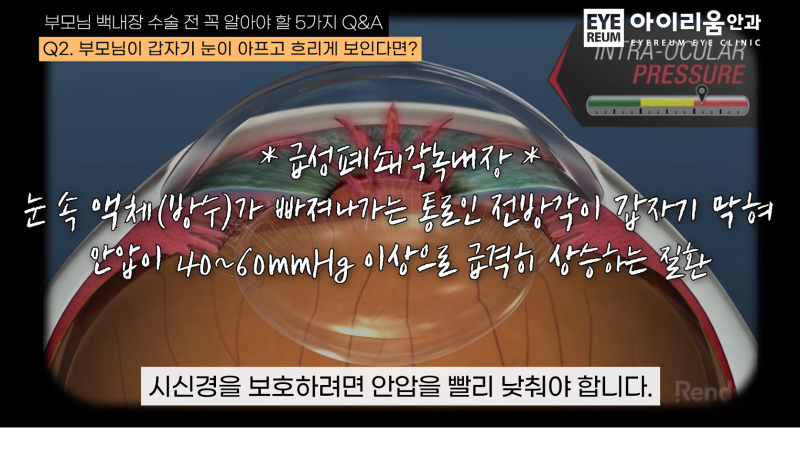
If you experience sudden, severe eye pain accompanied by blurred vision, headaches, or nausea and vomiting, you should not wait until the next day; seek immediate ophthalmologic care. These symptoms may signal an ocular emergency, such as acute angle-closure glaucoma, where aqueous humor drainage is blocked, causing an acute spike in intraocular pressure. In such scenarios, emergency treatment to lower intraocular pressure takes priority, after which laser therapy or the schedule for cataract surgery is determined according to the eye's condition.
Q3. Is cataract surgery possible if you have diabetes or hypertension?
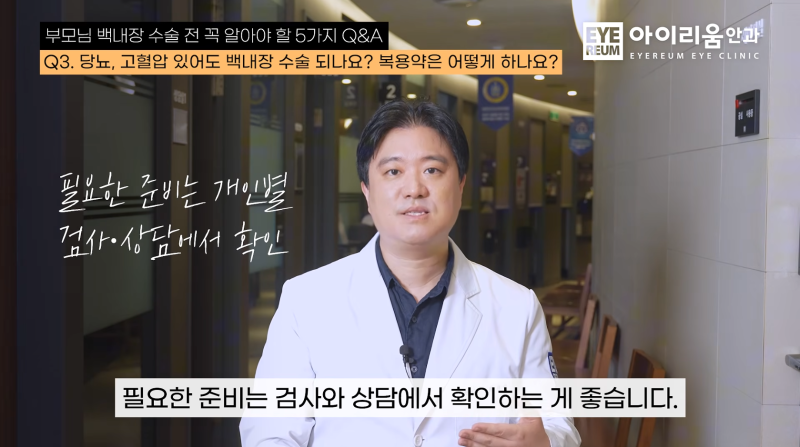
Having diabetes or hypertension alone does not disqualify you from undergoing cataract surgery. What matters most is how well these conditions are controlled and which medications you are taking.
In particular, medications for an enlarged prostate or blood thinners (anticoagulants/antiplatelets) require specific surgical considerations, so please inform the medical team of both current and past prescriptions. Do not stop taking your prescribed medications arbitrarily; bringing your medication bags or prescription photos will greatly facilitate the consultation.

Q4. Why is a retinal examination crucial if you have diabetes?
When planning cataract surgery for diabetic patients, it is vital to discern whether blurred vision is caused solely by cataracts or if concurrent diabetic retinal disorders exist. Diabetes impacts retinal blood vessels and can lead to diabetic retinopathy or macular edema. If such underlying problems are present, they can directly affect post-operative visual recovery. Therefore, prior to surgery, retinal photographs and OCT scans are conducted to evaluate the retina, and when necessary, retinal therapies and cataract surgery are coordinated in the proper therapeutic sequence.

Q5. Is an internal medicine clearance letter mandatory before cataract surgery?

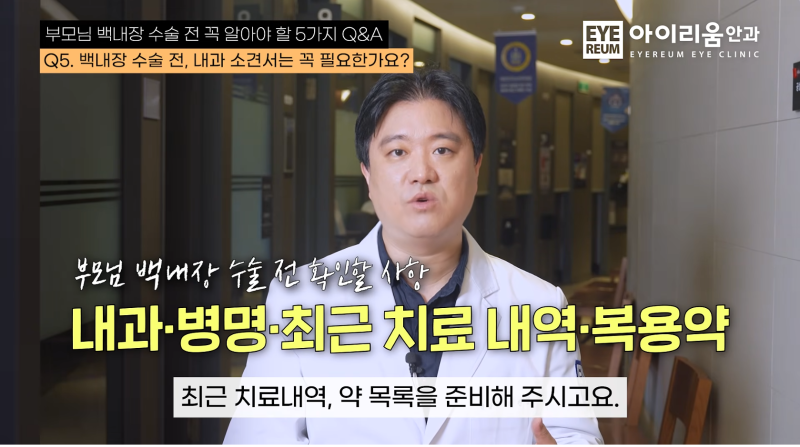
A medical clearance letter from an internal medicine physician is not mandatory for every cataract patient. However, if you have recently been treated for myocardial infarction, stroke, or undergone cardiac stent placement, or if your diabetes or hypertension is not stably managed, a medical consult or clearance may be requested to review your current physical status and medication protocol. Rather than simply being 'permission to operate,' this clearance serves as vital medical documentation enabling the surgical team to review systemic health risks and surgical precautions.
If you accompany your parents to the clinic, knowing their diagnosed medical conditions, recent treatment history, and a detailed list of current medications in advance will make the consultation much smoother.
Preparing for Your Parents' Cataract Surgery
Rather than deciding the timing of cataract surgery based solely on age or numerical visual acuity, it is crucial to evaluate lifestyle inconvenience, cataract progression, retinal and optic nerve health, underlying systemic diseases, and current medications. If your parents have chronic conditions like diabetes or high blood pressure or are on multiple medications, please prepare this information ahead of their visit.
At Eyereum Eye Clinic in Gangnam, we perform comprehensive cataract evaluations to assess your current ocular health and guide you through the optimal surgical timing and personalized treatment approach based on diagnostic results and daily living needs.
[Eyereum Eye Clinic Gangnam Location]

[Inquire & Book Comprehensive Cataract Exam for Parents]



#CataractSurgery #CataractSurgeryTiming #PreCataractSurgeryExam #CataractSurgeryPrecautions #SeniorCataractSurgery #DiabeticCataract #HypertensionCataract #CataractCheckup #CataractSymptoms #GangnamCataractSurgery #EyereumEyeClinic
Frequently Asked Questions
Below what vision level should cataract surgery be performed?
Cataract surgery is not decided solely by a specific visual acuity score. While medication and observation may be utilized early on, the decision is made by considering real-life difficulties—such as glare, climbing stairs, or driving—in tandem with the clinical progression of the cataract.
Does sudden severe eye pain and blurred vision indicate a cataract?
It is far more likely to be an emergency ocular condition such as acute angle-closure glaucoma. If sudden intense eye pain is accompanied by headache and nausea, do not wait until tomorrow; seek immediate ophthalmologic emergency care to reduce eye pressure.
Can patients with diabetes or hypertension still undergo cataract surgery?
Yes, patients with diabetes or hypertension can safely undergo cataract surgery. However, the control status of these conditions and medications—such as prostate drugs or blood thinners—must be reviewed. Do not discontinue medications on your own; bring your prescription to consult with the medical team.
Why is a retinal exam necessary for diabetic patients before cataract surgery?
It is essential to determine whether retinal disorders like diabetic retinopathy or macular edema are present. Retinal complications from diabetes directly impact visual recovery post-surgery, making pre-operative retinal photography and OCT scans critical.
Is an internal medicine clearance note always required prior to cataract surgery?
It is not mandatory for everyone, but it is necessary for patients with specific health issues. If you have recently suffered a heart attack or stroke, undergone stent placement, or have poorly managed blood pressure or blood sugar, an internal medicine consult or clearance is required for safety.