2026-10-16
What If You Had LASIK 20 Years Ago? Why a Corneal Exam Matters Before Cataract Surgery
Patients who had LASIK or LASEK decades ago may need a corneal exam before cataract surgery. Corneal topography and wavefront analysis help guide IOL selection and surgical planning.


Hello, this is Gangnam Eyereum Eye Clinic.
More and more people who had LASIK or LASEK some 20 years ago, and have lived without glasses for a long time, are now considering presbyopia or cataract surgery. As the first generation of LASIK and LASEK patients reaches the age when cataracts become a concern, cataract surgery on eyes that previously underwent vision correction has become an important topic at international ophthalmology conferences. In this context, Dr. Seong-yong Kang of Eyereum Eye Clinic gave a lecture titled ‘KLEx Vision Correction Followed by a Second Surgery: Cataract Surgery’ at the official ESCRS 2026 Instructional Course of the European Society of Cataract and Refractive Surgeons (ESCRS) in September.
What is an ESCRS Instructional Course?

The ESCRS Instructional Course is not simply a free-paper presentation. It is a formal educational program that systematically covers specific topics in cataract and refractive surgery. Course proposals undergo independent review and approval by the ESCRS Education Committee before being included in the program.
This lecture mainly addressed what must be considered when a patient who underwent KLEx vision correction, a procedure similar to SMILE, in their younger years undergoes cataract surgery decades later. Corneal changes caused by past vision correction can affect cataract evaluation, IOL power calculation, lens selection, and surgical planning.
Based on the presentation, let’s take a closer look at what changes in cataract surgery for eyes that previously had LASIK or LASEK.
Why should the cornea be checked first before cataract surgery after LASIK?
Cataract surgery involves removing the clouded natural lens and implanting an intraocular lens (IOL) in its place. However, the clarity of vision after surgery is not determined by the IOL alone, because the cornea is the first structure that light passes through when entering the eye.

LASIK and LASEK correct vision by changing the shape and refractive power of the cornea. Therefore, when planning cataract surgery for eyes that previously had vision correction, the current shape and optical properties of the cornea must also be evaluated. In particular, some patients who had LASIK or LASEK long ago may have residual corneal irregularities due to factors such as the position of the laser ablation center or the size of the optical zone at the time of surgery.
These changes may be associated with higher-order aberrations, which cannot be fully explained by standard myopic or astigmatic power alone. Put simply, this is the situation where the glasses prescription seems to fit well, yet light appears to spread or smear in one direction, or vision at night feels unclear.
Isn’t removing the cataract alone enough to restore clear vision?
As a cataract progresses, the clouded natural lens blurs vision. However, if the cornea also has irregularities or higher-order aberrations, the quality of vision may still be affected after cataract surgery.

Before surgery, the optical properties of the natural lens may partially offset corneal aberrations. Once the lens is removed during cataract surgery, glare or a decline in clarity that was not very noticeable before may become apparent. For this reason, patients who had LASIK or LASEK should have not only their cataract but also the current condition of their cornea thoroughly evaluated.
Can multifocal IOLs be used for cataract surgery after LASIK?
Having had LASIK does not automatically rule out multifocal IOLs. However, more careful lens selection is needed when the cornea is irregular or has significant higher-order aberrations. Multifocal IOLs are designed to provide vision at several distances, so if the corneal condition is poor, visual quality, such as glare and reduced clarity, may be affected.
Therefore, rather than deciding based solely on a wish to have a multifocal lens, it is important to first assess the current condition of the cornea through corneal topography and wavefront analysis, and then select the IOL.
If the cornea is irregular, can it be corrected first?
When corneal irregularities are judged likely to affect visual quality after cataract surgery, a staged approach can be considered: correcting the cornea before the IOL procedure.
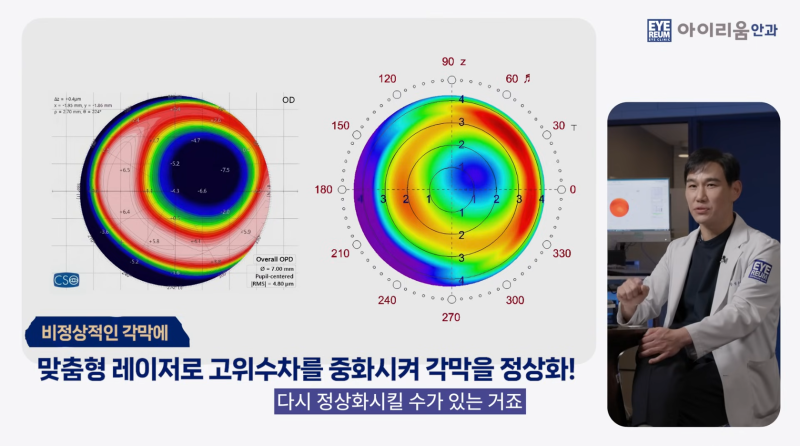
At our clinic, we analyze corneal shape and wavefront data using PERAMIS and MS-39. When necessary, we first correct corneal irregularities using CustomEyes and then plan cataract surgery. CustomEyes is a customized corneal correction method that analyzes each patient’s unique corneal shape and optical characteristics to design the procedure.

In other words, rather than choosing the lens type at the outset,
Check current corneal condition → Correct the cornea if needed → After the cornea stabilizes, select the IOL and perform cataract surgery
follow this sequence. Rather than deciding on a lens type from the start, the key is to first check the corneal condition that may affect vision after cataract surgery.
Cataract Surgery After LASIK or LASEK: Check This First
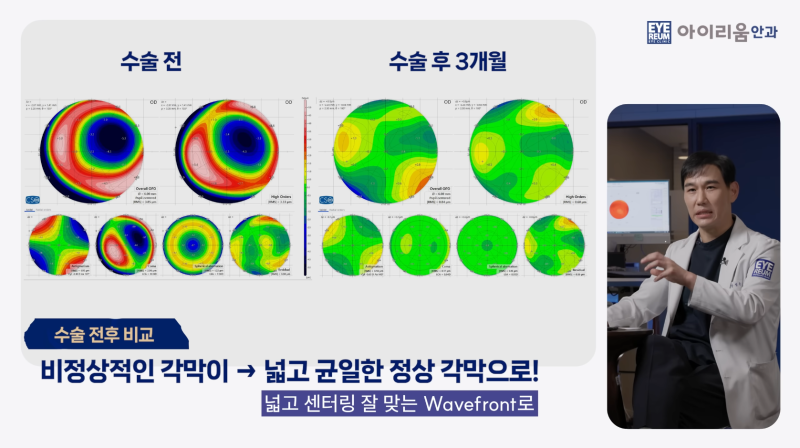
If you had LASIK or LASEK, it is important to check the shape of the cornea and higher-order aberrations through corneal topography and wavefront analysis before cataract surgery. Together with the corneal changes from past vision correction and the current degree of cataract, you should determine which type of lens, such as a monofocal or multifocal IOL, best suits your eyes.

If you have a history of LASIK or LASEK, be sure to tell your doctor during consultation, and have both the cornea and the lens evaluated before planning cataract surgery. Cataract surgery is not just about removing a clouded lens. It is a process of planning for post-surgery visual quality by considering the current condition of both the cornea and the lens.




#LASIKCataractSurgery #LASEKCataractSurgery #CataractSurgery #CornealExam #HigherOrderAberrations #MultifocalIOL #MultifocalCataractLens #PresbyopiaCataract #PresbyopiaCataractSurgery #CustomEyes #EyereumDrSeongyongKang #GangnamCataractSurgery #GangnamEyeClinic #EyereumEyeClinic
Frequently Asked Questions
What should be checked before cataract surgery after LASIK?
If you had LASIK or LASEK, it is important to check the shape of the cornea and higher-order aberrations through corneal topography and wavefront analysis before cataract surgery. Together with the degree of cataract, these results help determine which type of lens, monofocal or multifocal, is most suitable.
Won’t removing the cataract alone make my vision clear?
Not always. If the cornea has irregularities or higher-order aberrations, visual quality may still be affected after cataract surgery. Before surgery, the natural lens may partially offset corneal aberrations, so glare or reduced clarity may only become noticeable after the lens is removed.
Can I use a multifocal IOL after LASIK?
Having had LASIK does not automatically make a multifocal IOL impossible, but the choice should be made carefully based on corneal condition. If the cornea is irregular or has many higher-order aberrations, visual quality, such as glare and reduced clarity, may be affected. Corneal topography and wavefront analysis should be used to check this first.
If the cornea is irregular, can it be corrected first?
Yes. If corneal irregularities are judged likely to affect visual quality after cataract surgery, a staged approach can be considered, in which the cornea is corrected before surgery. The IOL is selected after the cornea has stabilized, and then cataract surgery is performed.
What should I tell my doctor before cataract surgery after LASIK?
If you have a history of LASIK or LASEK, it is best to inform your doctor during consultation. The clinic advises planning cataract surgery only after evaluating both the lens and the current condition of the cornea.
Do the same considerations apply to cataract surgery after SMILE?
Yes. If you have had SMILE or another past vision correction procedure, corneal changes must be considered during cataract surgery. These changes can also affect cataract evaluation, IOL power calculation, and lens selection.