2026-10-31
Toric ICL for Astigmatism Correction: Why Does Surgeon Experience Matter?
Why surgeon experience matters for Toric ICL astigmatism correction: lens rotation, axis alignment, vault, and when to realign or replace the lens.

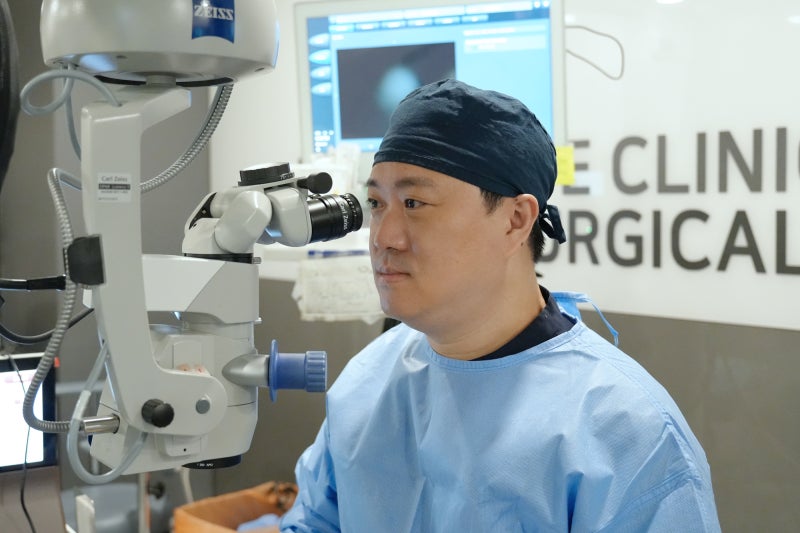
If you have high myopia and astigmatism together and are considering lens implantation surgery, you may be recommended a Toric ICL.
A Toric ICL is a lens implantation procedure that can correct not only nearsightedness but also astigmatism at the same time. However, unlike a standard ICL, precisely aligning the lens orientation to the astigmatic axis is critical. In particular, when the lens rotates after surgery, the decision on whether to re-operate is not based simply on how many degrees it has turned. Current vision, residual astigmatism, lens size and position, and the space within the eye all need to be evaluated together, which is why the experience and judgment of the medical team matter so much in astigmatism-correcting lens implantation.

In relation to this, Dr. Choi Jin-young, director of Eyereum Eye Clinic, explained in detail in a YouTube video why rotation of the Toric ICL lens matters, what should be checked when vision becomes blurry, and the criteria used to decide between follow-up observation, realignment, and lens replacement.
▶ Watch the video
In this post, based on that video, we'll walk through the key points of the astigmatic axis and rotational stability of the Toric ICL in an easy-to-follow way.

Why does lens rotation matter for Toric ICL?
Unlike myopia, astigmatism has not only a power but also a direction, known as the astigmatic axis. Therefore, a Toric ICL must also be inserted aligned to the astigmatic axis calculated from the examination results.

If the lens rotates away from the planned axis after surgery, the astigmatism correction effect may be reduced. The larger the astigmatism originally being corrected, the greater the impact on vision that the same degree of rotation can have.
However, a slight rotation of the lens does not mean that every case requires re-operation. The decision is made after evaluating current vision, remaining astigmatism, and any discomfort the patient is experiencing.
If vision is blurry after lens implantation, has the Toric ICL rotated?
Not necessarily. If vision becomes blurry after Toric ICL surgery, the first step is to confirm whether the lens has actually rotated. However, residual myopia or astigmatism power, dry eye, intraocular pressure or inflammation, and problems with the cornea or retina can also cause blurred vision.

Accordingly, a vision test and a refraction test are performed, and the following are checked:
- The current axis of the Toric ICL
- The astigmatic axis planned before surgery
- Residual astigmatism
- Other ophthalmic causes
All of these are assessed together.
Especially in high myopia, vision can decline without pain due to retinal problems, so if vision suddenly drops or discomfort persists, it is important to identify the cause through testing.
If a Toric ICL has rotated, do I need to have surgery again?
Even when rotation of a Toric ICL is confirmed, the same treatment is not applied in every case. In the video, Dr. Choi Jin-young, an ophthalmologist, explains that the decision is made based on three main options: follow-up observation, realignment, and lens replacement.
1. Follow-up observation if vision is minimally affected
If the lens has rotated slightly but its effect on vision and residual astigmatism is minimal and the patient does not experience any particular discomfort, the lens can be monitored over time.
In this case, in addition to lens rotation, we also check whether the lens is staying safely in place within the eye, including the vault and the anterior chamber angle.
2. Realignment if rotation is the cause of astigmatism and vision loss
If lens rotation is confirmed as the actual cause of vision loss and residual astigmatism, and the current lens size and conditions inside the eye are appropriate, realignment may be considered.
Realignment does not involve replacing the lens with a new one; rather, it means repositioning the rotated Toric ICL back to the astigmatic axis originally planned.

3. Lens replacement may also be considered if it rotates again
If the lens has rotated significantly without any particular trauma, or a lens that was realigned once has rotated again, it is necessary to determine why the lens is unstable, rather than simply repeating the axis adjustment.
After re-evaluating lens size, vault, anterior chamber angle, and how well the lens is supported within the eye, lens replacement may be considered if necessary.
Lens size also matters for Toric ICL
The stability of a Toric ICL is affected not only by the astigmatic axis but also by lens size and how well the lens is supported within the eye. Depending on the situation, a lens one size larger may be considered. However, while a larger lens can improve stability, the possibility of a narrower anterior chamber angle must also be taken into account.
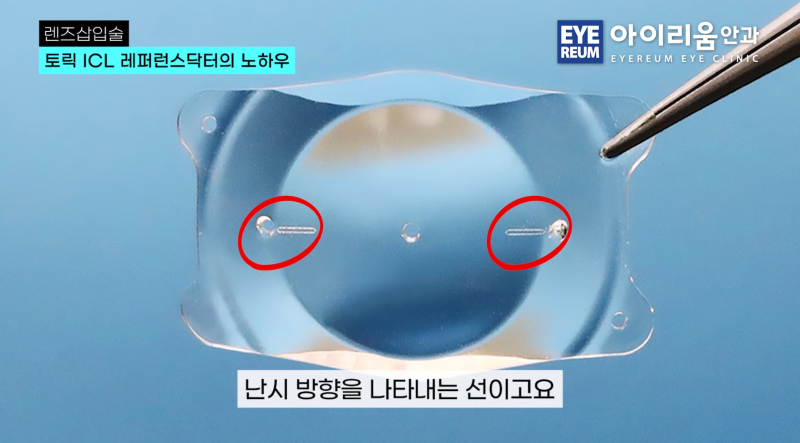
Therefore, it cannot simply be said that a larger lens is always better. It is important to determine the lens size and insertion orientation by considering both rotational stability and a safe amount of space within the eye.
Why surgeon experience matters for Toric ICL
With Toric ICL, the process does not end simply with placing the lens along the astigmatic axis. Before surgery, the lens size must be planned to match the degree and axis of astigmatism and the structure of the eye; after surgery, lens rotation, residual astigmatism, vault, and anterior chamber angle must be monitored together.

Even when rotation is confirmed, the decision on whether to monitor, realign, or replace the lens may differ from patient to patient.
Eyereum Eye Clinic has published a study titled “Rotational Stability and Visual Outcomes of V4c Toric Phakic Intraocular Lenses” in the SCI-indexed international journal Journal of Refractive Surgery, which analyzed the rotational stability and visual results of Toric ICL.
(J Refract Surg. 2018;34(7):489-496)
Drawing on this experience of continuously studying the rotational stability and clinical outcomes of Toric ICL, the clinic carefully monitors everything from lens selection before surgery to postoperative progress.
If you are considering astigmatism-correcting lens implantation
Astigmatism-correcting lens implantation is not just about inserting a lens designed for astigmatism. It is important to accurately confirm the astigmatic axis, lens size, and space within the eye, and to consistently monitor whether the lens remains stable even after surgery.
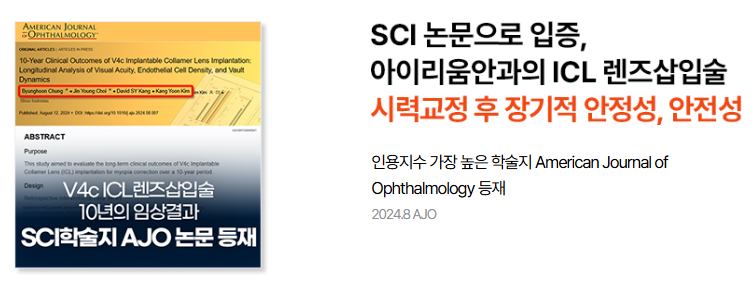
Drawing on its research experience, including the publication of 10-year long-term clinical results of ICL lens implantation in an SCI-indexed international journal, Eyereum Eye Clinic carefully monitors patients from detailed preoperative examinations through long-term postoperative follow-up.
If you are considering a Toric ICL, have residual astigmatism after lens implantation, or notice blurred vision, consider a detailed examination to check your current lens position and astigmatism status. For vision correction that considers lifelong eye health, Eyereum Eye Clinic in Gangnam will be with you.

Toric ICL Lens Implantation Q&A
Q. Do I always have to have surgery again if the Toric ICL rotates slightly?
No. The decision is not based on the rotation angle alone; current vision, residual astigmatism, the degree of discomfort, and lens stability are all evaluated together.
Q. What happens if a realigned Toric ICL rotates again?
If the lens keeps rotating, rather than repeating the same realignment, lens size, vault, anterior chamber angle, and other factors are re-evaluated, and lens replacement may be considered if necessary.




#AstigmatismCorrectionICL #ToricICL #AstigmaticLensImplantation #LensImplantation #ICLLensImplantation #ICLRotation #ToricLensImplantation #LensReplacement #ICLVault #HighMyopia #HighAstigmatism #AstigmatismCorrection #EVOICL #LensImplantationExam #GangnamLensImplantation #GangnamEyeClinic #EyereumEyeClinic
Frequently Asked Questions
Do I always need to have surgery again if the Toric ICL rotates slightly?
No. Re-operation is not decided based on rotation angle alone. Current vision, residual astigmatism, the degree of discomfort the patient feels, and lens stability are all evaluated together.
If vision is blurry after lens implantation, has the Toric ICL rotated?
Not necessarily. Causes of blurred vision can include residual myopia or astigmatism, dry eye, intraocular pressure or inflammation, and problems with the cornea or retina, in addition to lens rotation. These are all checked together through a vision test and a refraction test.
What criteria are used to decide between realignment and lens replacement?
If lens rotation is confirmed as the cause of vision loss and residual astigmatism, realignment may be considered. Realignment does not involve replacing the lens with a new one; it repositions the lens to the originally planned astigmatic axis. If the lens rotated significantly without any particular trauma, or rotated again after realignment, vault, anterior chamber angle, and other factors are re-evaluated, and lens replacement may be considered if necessary.
Is a larger Toric ICL always better?
No. Depending on the situation, a lens one size larger may be considered. However, while a larger lens can improve stability, the possibility of a narrower anterior chamber angle must also be checked.
What is checked before and after Toric ICL surgery?
Before surgery, the lens size is planned to match the degree and axis of astigmatism and the structure of the eye, and a detailed examination is carried out. After surgery, lens rotation, residual astigmatism, vault, and anterior chamber angle are checked together.