2026-11-01
SMILE LASIK: Why Does Satisfaction Differ With the Same 1.0 Vision? Why 'Quality of Vision' Matters
Even with the same 1.0 vision, SMILE LASIK satisfaction can differ. This article explains how higher-order aberrations affect visual quality and why precise examination matters.


SMILE LASIK: Why Does Satisfaction Differ With the Same 1.0 Vision? Why 'Quality of Vision' Matters
If my vision is 1.0 after surgery, aren't the results all the same?
This is one of the most common questions from people considering SMILE LASIK.
To answer up front, satisfaction with surgery can differ even with the same 1.0 vision.

Some people say after surgery, "It's really clear!" while others complain of discomfort from night-time halos or glare.
This is why recent vision correction surgery places greater emphasis not just on the number on the eye chart, but on how sharp and comfortable vision is. In other words, it focuses on Quality of Vision.
Why does satisfaction differ with the same 1.0 vision?
Just because someone reads 1.0 on an eye chart doesn't mean everyone experiences the same visual clarity.
A key factor that determines satisfaction after surgery is higher-order aberrations.

Higher-order aberrations are optical distortions that are difficult to fully correct even with eyeglasses or contact lenses, and they directly affect the quality of vision patients perceive after surgery.
When higher-order aberrations increase, the following symptoms may occur:
- Night-time halos
- Glare
- Reduced contrast sensitivity
- Decreased sharpness
- A feeling of blurred vision
Even with the same 1.0 vision, the quality of vision and surgical satisfaction can vary depending on the degree of higher-order aberrations.
Why is reducing higher-order aberrations important in SMILE LASIK?
Recent vision correction surgery has moved beyond simply correcting vision. It is evolving toward improving the quality of vision by reducing the higher-order aberrations generated during the procedure.
A representative example is Low Energy SMILE.

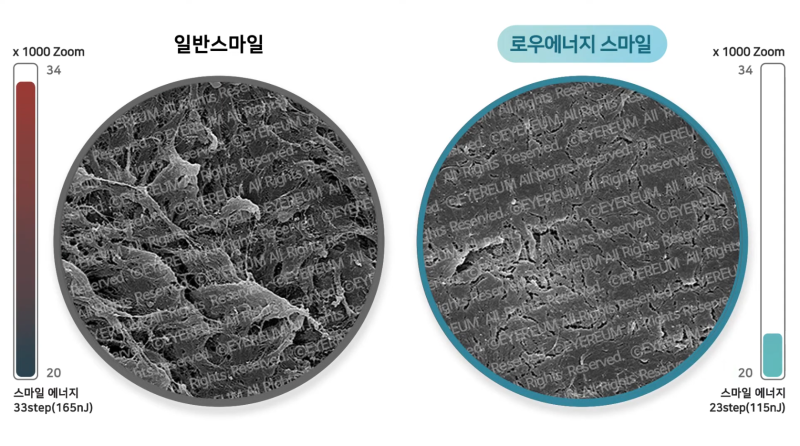
Eyereum Eye Clinic has continuously studied how laser energy affects corneal tissue, and has developed Low Energy SMILE based on that research.
Lowering laser energy during SMILE surgery helps reduce thermal damage to the cornea and creates a smoother cut surface.

The smoother the cut surface, the less light scattering occurs and the lower the risk of higher-order aberrations. As a result, a positive effect on night vision and sharpness can be expected.
How is Plasma SMILE different?
Low Energy SMILE was applied to SMILE pro, the latest femtosecond laser platform, and evolved into Plasma SMILE.
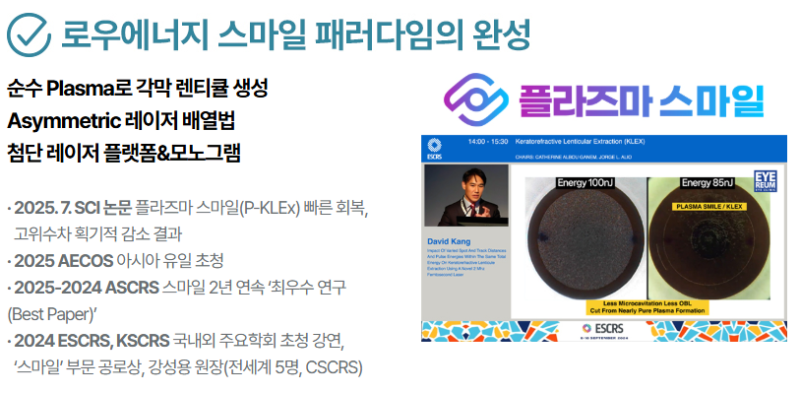
Plasma SMILE is a procedure that uses pure plasma at an ultra-low energy level to form the lenticule inside the cornea, focusing on reducing postoperative higher-order aberrations and improving the quality of vision.
In fact, a study by Eyereum Eye Clinic published last year in an international SCI-indexed ophthalmology journal found that Plasma SMILE showed less increase in coma and spherical aberration compared with conventional SMILE surgery. Visual recovery was also stable at 2 weeks and 2 months after surgery.
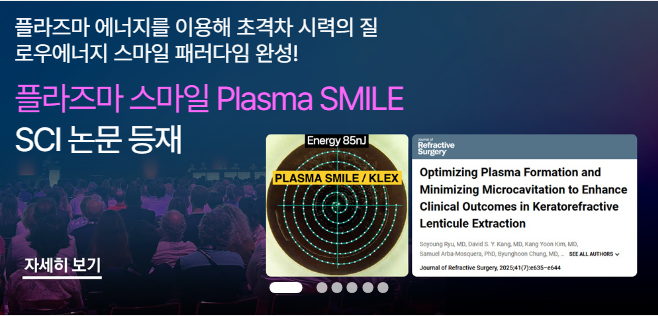
These findings suggest that precisely controlling laser energy and surgical design can help improve the quality of vision after surgery.
Surgical centration is also a key factor in determining the quality of vision
Beyond laser energy, how accurately the surgical center is aligned is also an important factor in determining the quality of vision.
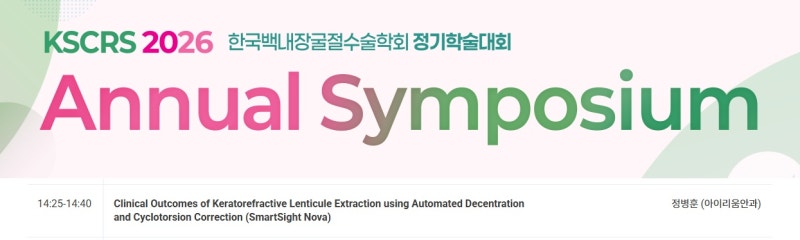
Dr. Byung-hoon Jung recently presented clinical research on the SmartSight Nova, which features CenTrax®, an automatic centration correction technology, at the 2026 Korean Society of Cataract and Refractive Surgery (KSCRS).
In the SMILE LASIK study, the SmartSight Nova surgery group showed that corneal lenticules formed more accurately at the planned position than with conventional SMILE. Visual recovery, safety, and refractive predictability remained at levels similar to existing methods.


These results show that, to improve the quality of vision, it is important not only to reduce higher-order aberrations but also to accurately align the surgical center by taking into account each patient's unique eye characteristics.
Good vision starts with a precise examination
No matter how advanced the equipment or surgical technique, the same outcome cannot be guaranteed for everyone.
This is because each patient's corneal shape and thickness, higher-order aberrations, and optical characteristics of the eye are all different.
Therefore, a precise examination is not simply a process to confirm whether surgery is possible. It is a key step in establishing the most suitable surgical method and plan for each patient.

At Eyereum Eye Clinic, we analyze the anterior and posterior corneal structure using the MS-39, and precisely evaluate the overall optical characteristics of the eye and its higher-order aberrations using PERAMIS.
In addition, research involving medical professionals has led to the development of an AI-based analysis technology that combines corneal tomography with corneal biomechanical data. This enables more accurate prediction of the risk of corneal ectasia, such as keratoconus.
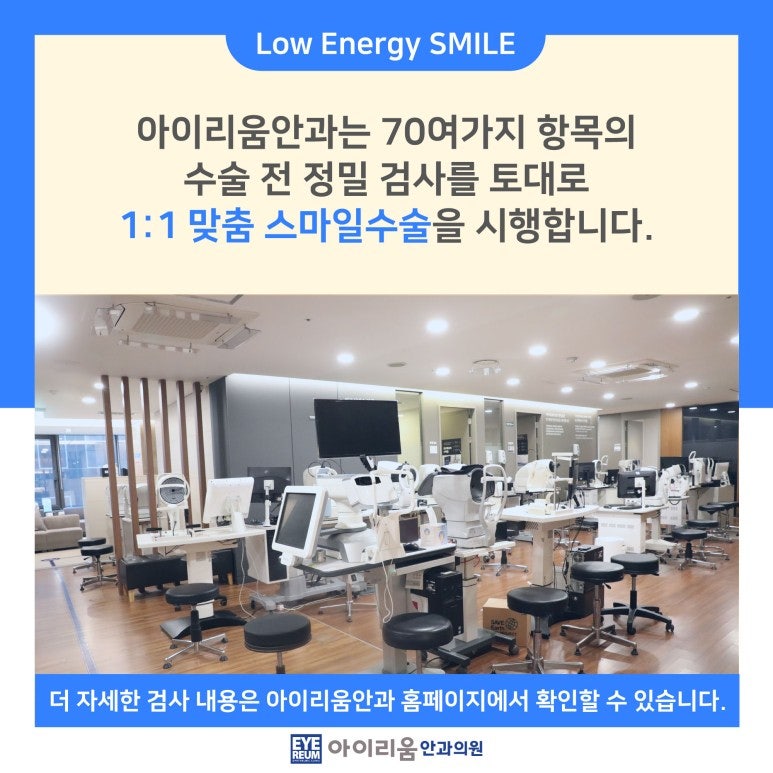
A precise examination is both a process for safe surgery and the first step toward reflecting each patient's unique eye characteristics in a customized procedure.
If you are considering SMILE LASIK, look at 'quality of vision' as well as '1.0'
The goal of vision correction surgery is not simply to achieve the number 1.0.

After surgery,
How clearly you can see
Whether you can see comfortably at night
Whether halos and glare are minimal
Whether stable vision can be maintained over the long term
Only when all of these are considered together can you expect high surgical satisfaction.
Therefore, when choosing SMILE LASIK, it is important to check not only the surgical equipment but also how precisely the clinic analyzes your eye condition and reflects those results in the surgical plan.
Ultimately, good vision is not achieved by the latest equipment alone. It is truly achieved when precise examination and a customized surgical plan come together.
SMILE LASIK Q&A
Q. If my vision is 1.0 after SMILE LASIK, are the results all the same?
A. No.
Even with the same 1.0 vision, the quality of vision, such as night-time halos, glare, contrast sensitivity, and sharpness, can differ depending on the degree of higher-order aberrations.
Q. What are higher-order aberrations?
A. Higher-order aberrations are optical distortions that are difficult to fully correct even with eyeglasses or contact lenses.
They can affect postoperative satisfaction with vision and night vision, which is why they are an important consideration in recent vision correction surgery.
Q. How does Plasma SMILE differ from conventional SMILE LASIK?
A. Plasma SMILE is a procedure that uses an ultra-low-energy laser to reduce corneal damage and create a smoother cut surface. Its goal is to reduce higher-order aberrations and improve the quality of vision.
Q. Why is a precise examination important?
A. Because each patient has different corneal structure, higher-order aberrations, and biomechanical characteristics.
A precise examination helps establish the surgical method and plan best suited to each individual, which contributes to greater safety and surgical satisfaction.
Eyereum Eye Clinic Gangnam is directly connected to Exit 2 of Gangnam Station.
Plan your vision correction surgery more safely with a procedure that fits you.
#SmileLASIK #LowEnergySMILE #PlasmaSMILE #SmartSightNova
#HigherOrderAberrations #SmileLASIKStudy #GangnamEyeClinic #EyereumEyeClinic #QualityOfVision


Frequently Asked Questions
If my vision is 1.0 after SMILE LASIK, are the results all the same?
No. Even with the same 1.0 vision, the quality of vision, such as night-time halos, glare, and reduced contrast sensitivity, can vary depending on the degree of higher-order aberrations, which can lead to differences in surgical satisfaction.
What are higher-order aberrations?
Higher-order aberrations are optical distortions that are difficult to fully correct even with eyeglasses or contact lenses. They can affect postoperative vision quality and night vision, making them an important factor in recent vision correction surgery.
How does Plasma SMILE differ from conventional SMILE LASIK?
Plasma SMILE is a procedure that uses ultra-low-energy plasma to form the lenticule inside the cornea, focusing on reducing higher-order aberrations and improving the quality of vision. The article also introduces research showing less increase in coma and spherical aberration compared with conventional SMILE surgery.
Why is a precise examination important?
Because each patient's corneal shape and thickness, higher-order aberrations, and optical characteristics of the eye differ, it is important to establish a surgical method and plan tailored to the individual. The article explains that a precise examination is not merely a check of whether surgery is possible, but a key step toward improving safety and surgical satisfaction.
What should I check to improve satisfaction with SMILE LASIK?
It is best to check postoperative sharpness, night vision, the extent of halos and glare, and whether vision remains stable over the long term. The article also recommends looking beyond surgical equipment alone to see how precisely a clinic analyzes your eye condition and reflects it in the surgical plan.