2026-11-04
How to Choose a Good ICL Clinic ② – Lens Size, Vaulting, and Why Toric ICL Matters
This second installment of Dr. Choi Jin-young's ICL clinic guide explains how lens size, vaulting, and CLR are considered and why rotational stability matters for Toric ICL.
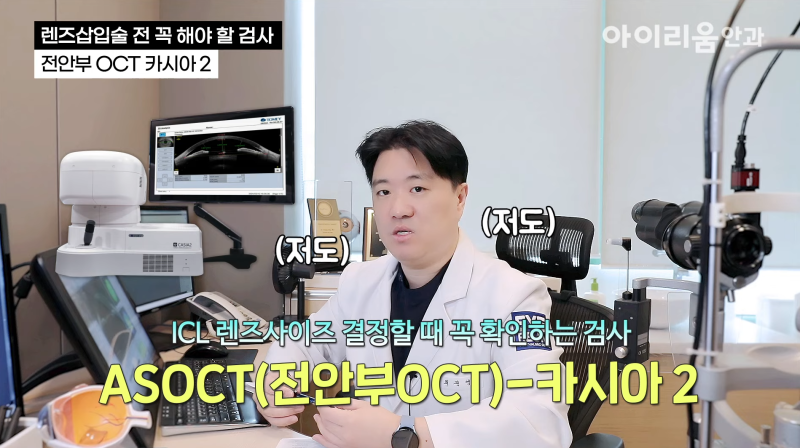
📖 Dr. Choi Jin-young's Lens Implantation Guide

Lens implantation surgery (ICL) is not simply a procedure that corrects myopia and astigmatism power. The most important step is accurately analyzing each patient's unique eye structure and selecting the appropriate lens.
In the series "How to Choose a Good ICL Clinic" by Dr. Choi Jin-young of Eyereum Eye Clinic, we walk through, step by step, the criteria that anyone considering lens implantation should know.
✔ Part 1 | Surgical Experience, Official Accreditation, and Precision Testing
✔ Part 2 | Lens Size, Vaulting, and Toric ICL
Hello, this is Gangnam Eyereum Eye Clinic.
In our previous post, we discussed the importance of checking surgical experience and official accreditation when considering ICL lens implantation, as well as the precision testing equipment used and how the test results are interpreted.
In this post, we'll look at how the right lens size is determined for each patient's eye, and explore vaulting and Toric ICL, two important factors in ICL surgery.
Why is lens size so important in lens implantation surgery?
Lens implantation surgery corrects vision by inserting a specialized vision-correcting lens inside the eye, without cutting the cornea.

Lens implantation procedures are classified by where the lens is placed: anterior chamber lens implantation, where the lens is inserted in front of the iris, and posterior chamber lens implantation, where it is placed between the iris and the crystalline lens. ICL (Implantable Collamer Lens), the most widely performed procedure in Korea, is a representative posterior chamber lens procedure.
Even when two patients have the same myopia or astigmatism power, the structure of the space inside each eye differs from person to person. That means choosing the correct lens size, not just the power, can have a major impact on surgical outcomes.
What is vaulting in ICL lens implantation?
One of the most important concepts in ICL is vaulting.
Vaulting refers to the distance between the ICL lens and the crystalline lens.
If vaulting is too low, the lens can get too close to the crystalline lens. Conversely, if it is too high, it can affect the anterior chamber angle or intraocular pressure.
For this reason, ICL is not simply a procedure to insert a lens. It is a vision correction surgery that must also account for the position the lens will maintain inside the eye after surgery.
To achieve this, a range of factors must be evaluated comprehensively, including anterior chamber depth (ACD), axial length, and corneal size. What matters most is not simply looking at test values, but how the results are interpreted and applied to lens size and the surgical plan.
What is vaulting in ICL lens implantation?
Eyereum Eye Clinic has been steadily researching lens size and vaulting.
While performing lens implantation surgery, Eyereum Eye Clinic has also continued research to more accurately predict the ICL lens size and vaulting that suit each patient's eye.
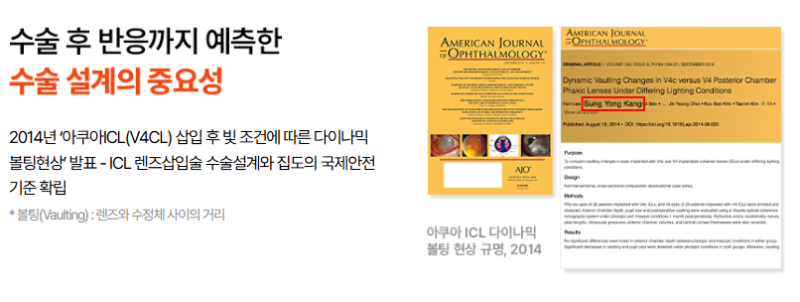
- 2011: Presented biometric factors affecting vaulting after ICL implantation at the American Society of Cataract and Refractive Surgery (ASCRS)
- 2014: Reported the dynamic vaulting phenomenon, in which vaulting changes with the amount of light, in the American Journal of Ophthalmology (AJO), an international ophthalmology journal,
- 2018: Published a study in the international journal BMC Ophthalmology analyzing the relationship between preoperative factors, such as anterior chamber depth, pupil size, and axial length, and optimal vaulting
Recently, we have also been taking CLR (Crystalline Lens Rise) into account.
CLR is a value that indicates how far forward the crystalline lens sits within the eye.
Even eyes that appear to have the same conditions can have different postoperative vaulting depending on crystalline lens position. For this reason, research on determining lens size by analyzing CLR alongside existing test parameters is being actively conducted.

Dr. Choi Jin-young of Eyereum Eye Clinic presented these findings at the 2025 Korea EVO ICL Forum, and recent studies have also reported a tendency for postoperative vaulting to be lower in eyes with higher CLR.
If you have astigmatism, you should also look into Toric ICL.
For patients with astigmatism, Toric ICL is considered.
Unlike standard ICL, it is essential to insert Toric ICL with its axis precisely aligned to the astigmatism.
This is because astigmatism has directionality. Even a slight rotation of the lens inside the eye after surgery can reduce the planned astigmatism correction.
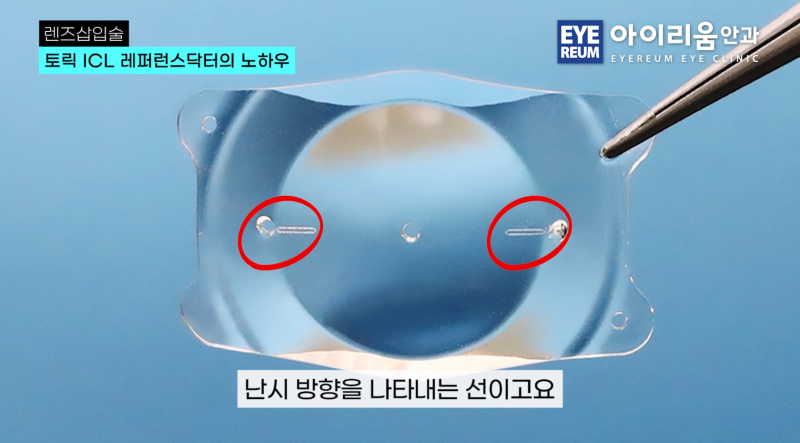
Clinical studies have reported that a rotation of only about 3 degrees in a Toric ICL can reduce the astigmatism correction effect by approximately 10%.
Therefore, with Toric ICL, securing rotational stability, not just lens power, is important.

At Eyereum Eye Clinic, we use the ZEISS CALLISTO eye system to align the lens with the astigmatism axis planned before surgery. We also perform surgery with rotational stability in mind, so the lens stays stably positioned throughout the procedure.
At the same time, Dr. Choi Jin-young has continued to research the rotational stability and visual outcomes of Toric ICL, and in 2018 published related findings in the international journal Journal of Refractive Surgery.
A Guide to Safe Toric ICL Lens Implantation
By analyzing each patient's unique eye structure to select the appropriate lens size, predicting postoperative vaulting, and, for patients with astigmatism, also considering the lens axis and rotational stability, more stable results can be expected.
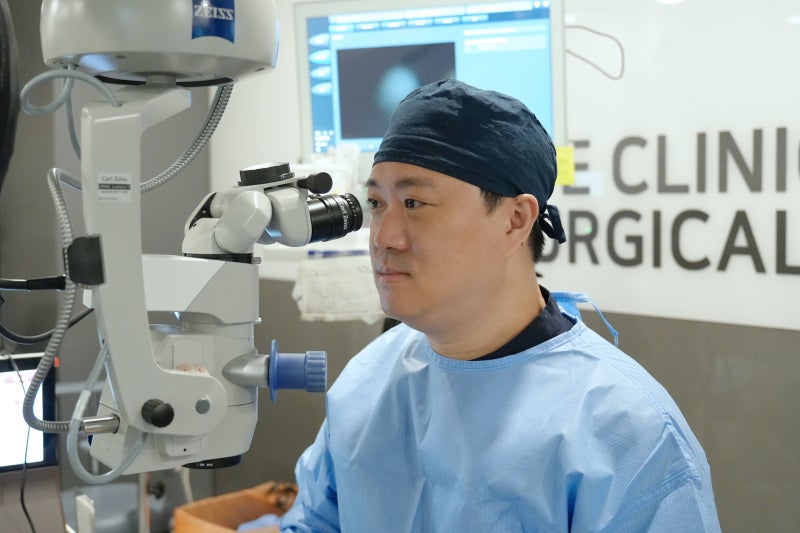
If you are considering lens implantation, rather than just asking "Is surgery possible for me?", we recommend discussing with your doctor the criteria used to determine lens size, how vaulting is predicted, and, if you have astigmatism, how Toric ICL would be planned.
Eyereum Eye Clinic will continue to share helpful information for those considering lens implantation surgery through Dr. Choi Jin-young's lens implantation guide.
You can also refer to Dr. Choi Jin-young's YouTube channel at Eyereum Eye Clinic.
#ICLClinicGuide #ICLLensImplantation #ToricICL #LensImplantationAstigmatismCorrection
#LensSize #ICLVaulting #LensImplantationSCIPapers #EyereumEyeClinic #LensImplantationChoiJinyoung