2026-10-14
Curious About New SMILE LASIK? Understanding the Difference Between SMILE Pro and SmartNova
Compares SMILE LASIK, SMILE Pro, and SmartNova (New SMILE LASIK), covering low-energy and plasma SMILE, centration correction, and how to choose the right procedure.
Hello, this is Eyereum Eye Clinic.
When you start looking into vision correction surgery these days, you probably come across terms like SMILE LASIK, SMILE Pro, New SMILE LASIK, SmartLASIK, and more...
With so many surgery names that sound alike and procedures that seem similar, the more you research, the more confusing it gets. Sound familiar?

To start with a brief summary:
SMILE LASIK, SMILE Pro, and SmartNova are all vision correction procedures in which a lenticule is created inside the cornea and removed through a small incision.
The most suitable SMILE procedure is determined based on detailed examination results. Recently, SMILE-based vision correction has been evolving to focus not only on ‘which device is used,’ but also on how the laser is configured and how it is applied to each patient’s eye.
What Is SMILE LASIK?
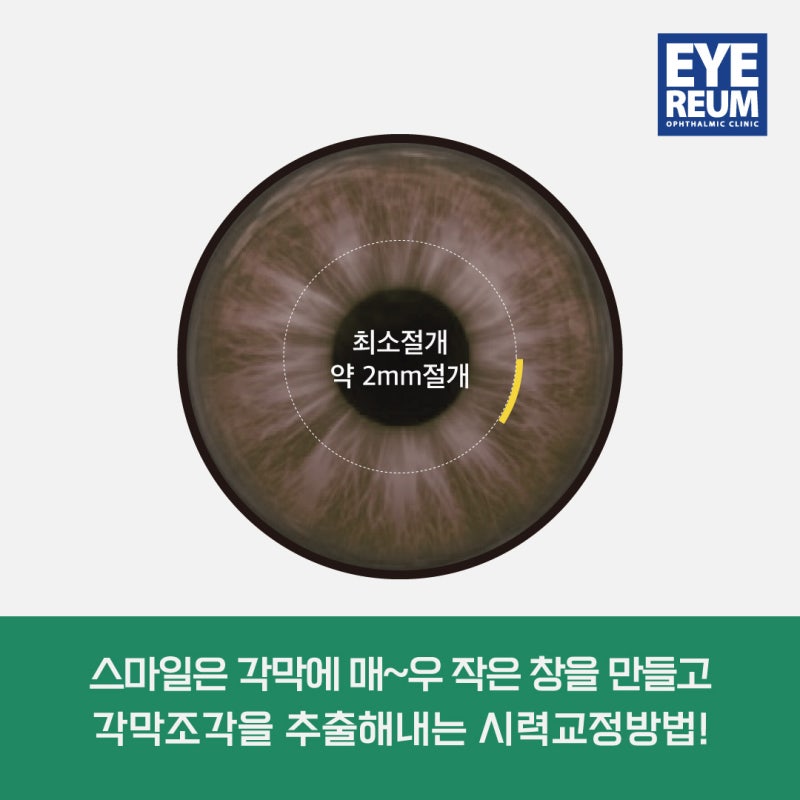
SMILE LASIK corrects nearsightedness and astigmatism by creating a corneal tissue piece called a lenticule inside the cornea in the amount needed for correction, then removing it through a small incision. Unlike traditional LASIK, it does not create a corneal flap, and unlike LASEK, it does not remove the corneal epithelium. Instead, it uses a minimal incision of about 1–2 mm on the corneal surface, which offers the advantages of less pain during surgery and faster physical recovery.
However, even within SMILE LASIK, detailed procedures can vary depending on laser energy, spot spacing, and treatment centration. This is exactly the area that Eyereum Eye Clinic has studied for many years.
Low Energy SMILE
Since the early days of introducing SMILE LASIK, our clinic has focused on postoperative vision quality and has been researching Low Energy SMILE. Low Energy SMILE is a method that forms the lenticule by lowering the energy of the femtosecond laser used in SMILE surgery. In an SCI-indexed paper published by our clinic’s medical team, lowering the laser energy resulted in a smoother corneal cut surface and a reduction in higher-order aberrations, which may be associated with night-time halos and glare.
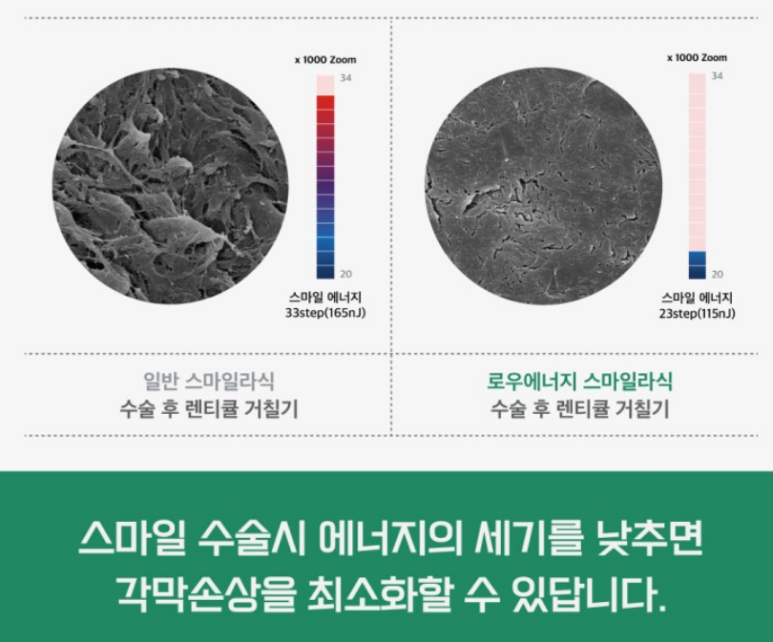
These changes may help improve visual quality after surgery. To put it simply, it is similar to how a clean, smooth eyeglass lens feels more comfortable and clearer to look through than one with scratches.
How Is SMILE Pro Different?
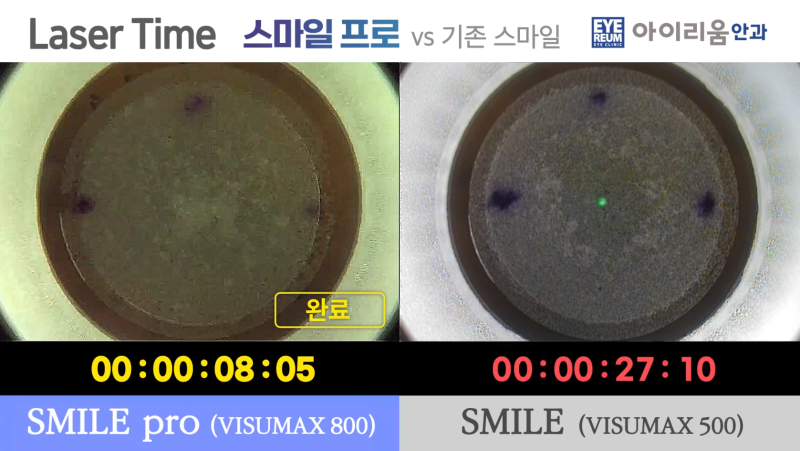
SMILE Pro uses a different laser compared with conventional SMILE LASIK. By applying the new VISUMAX 800 system, laser treatment time is shortened, which can help reduce the amount of time the patient needs to keep the eye fixed during surgery.
However, even with new equipment, speed is not the only thing that matters.
This is because laser energy and delivery method can also affect postoperative vision quality. This line of research led to Plasma SMILE.
Plasma SMILE for Even Higher Vision Quality
Plasma SMILE takes Low Energy SMILE a step further by applying an asymmetric laser spot arrangement at low laser energy. It was investigated with the aim of more precisely controlling the plasma and microbubbles generated inside the cornea, thereby reducing postoperative higher-order aberrations and improving early vision quality. The related clinical study was published in 2025 in the international journal ‘Journal of Refractive Surgery (JRS)’.
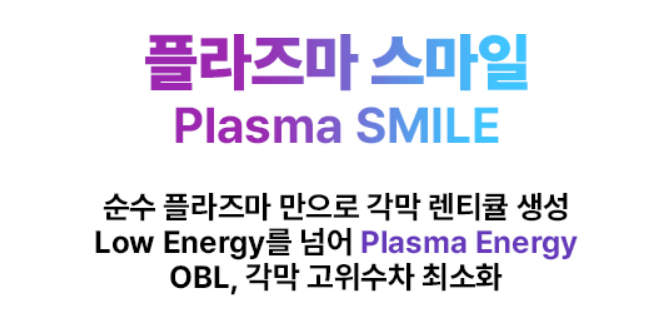
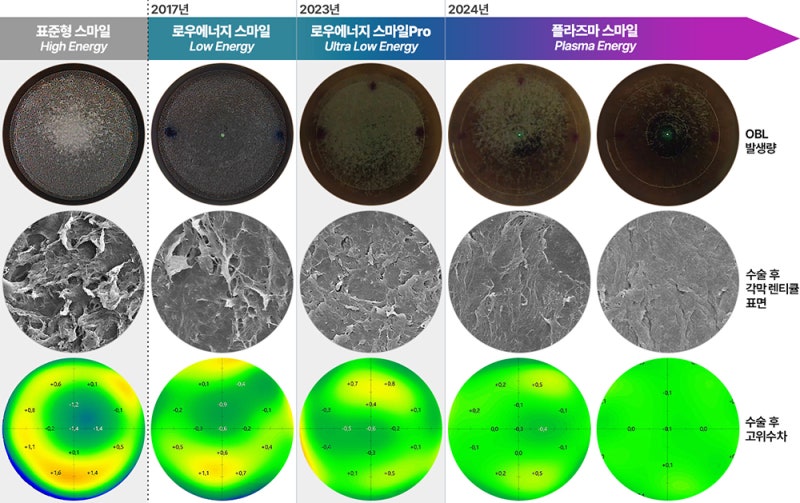
According to the paper, Plasma SMILE showed fewer postoperative higher-order aberrations, such as coma and spherical aberration, compared with the conventional method. It also showed better results in uncorrected visual acuity (vision measured without glasses or contact lenses) at 2 weeks and 2 months after surgery. The key is not simply switching to a newer device, but lowering the laser energy to the level needed for plasma formation and finely adjusting the spot and track settings to improve vision quality.
What Are New SMILE LASIK and SmartNova?
SmartNova, known as New SMILE LASIK, uses the ATOS laser from Germany’s SCHWIND. What sets it apart from conventional SmartLASIK is that its CenTrax feature allows the treatment center to be checked and corrected during surgery, and cyclotorsion can also be corrected based on examination data.
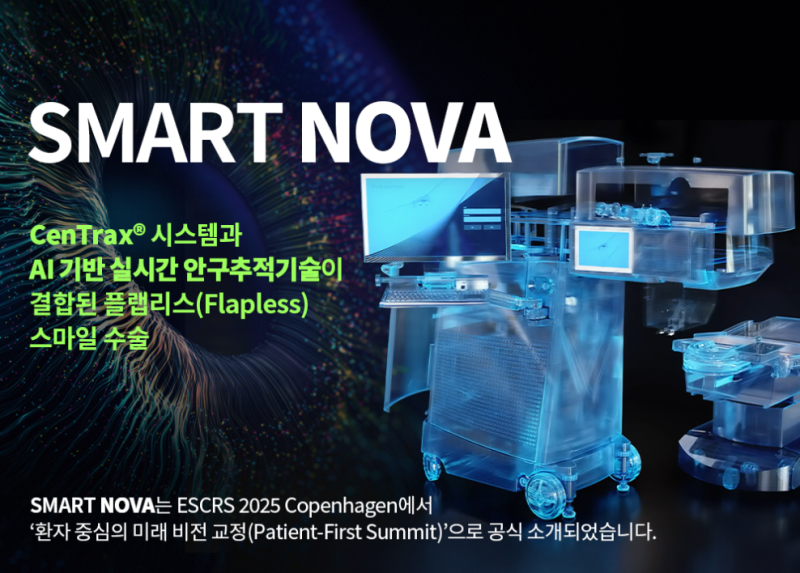
SmartNova is designed to link examination data with the surgical equipment so that these rotational changes and the treatment center can be corrected. In other words, SmartNova is not simply about using new equipment; it can be seen as an approach that focuses on aligning the treatment center and the astigmatic axis more precisely.
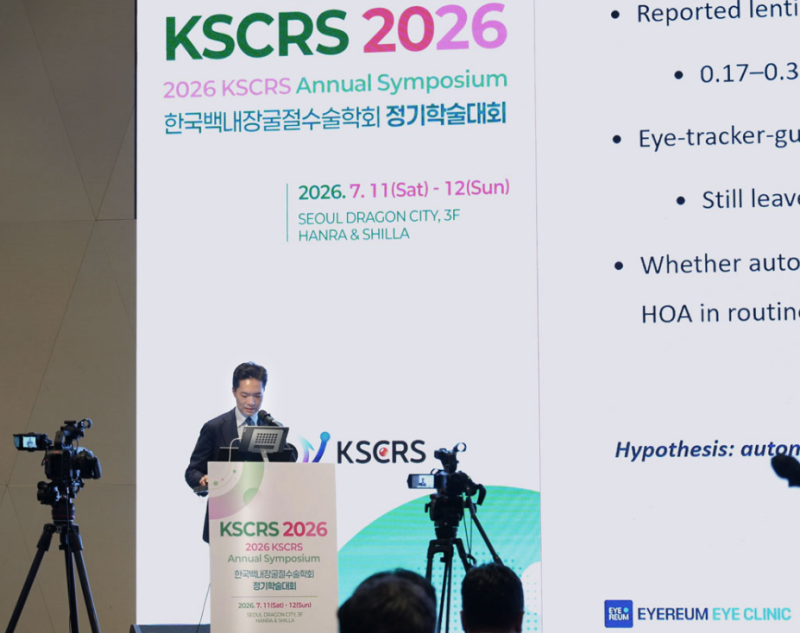
We have also verified through clinical research how these correction features affect actual surgical outcomes. Director Jeong Byeong-hun of Eyereum Eye Clinic presented clinical results at the 2026 Korean Society of Cataract & Refractive Surgery (KSCRS), comparing conventional SmartLASIK (SmartSight) with SmartNova (SmartSight NOVA), which applies CenTrax. The study analyzed treatment center position, visual acuity, refractive outcomes, and corneal higher-order aberrations. In the SmartNova group, improved accuracy of the treatment center was observed. In contrast, visual acuity and refractive outcomes at 1 month, as well as higher-order aberrations, were similar to those of the conventional method.
Which Surgery Is Better?
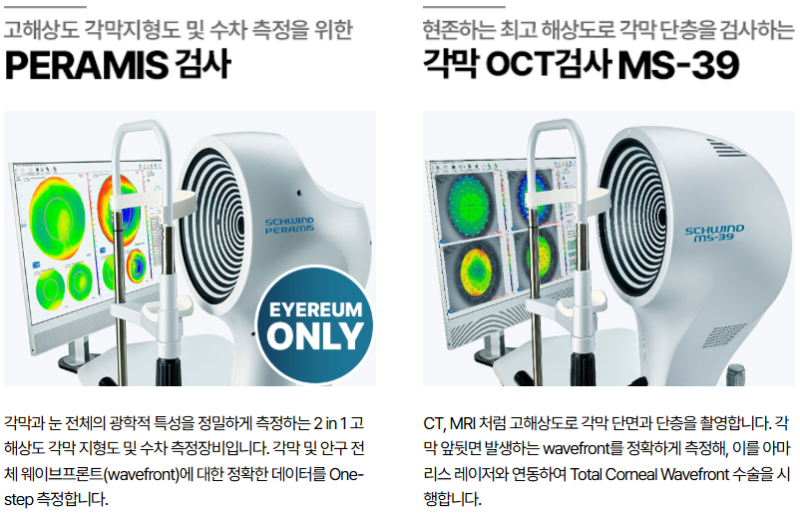
Many people ask whether SMILE Pro or SmartNova is better. However, the newest equipment is not necessarily the best fit for every eye. For a precise procedure, it is important to first accurately assess the patient’s eye. In addition to nearsightedness and astigmatism measurements, we check the anterior and posterior corneal structure, epithelial thickness, wavefront, and higher-order aberrations using precision diagnostic equipment such as MS-39 and PERAMIS, and reflect these findings in the surgical plan. Depending on the examination results, LASEK or implantable collamer lens (ICL) surgery may be more suitable than SMILE Pro or SmartNova. Ultimately, what matters more than the latest equipment is choosing the procedure that fits your eyes.
We go beyond simply achieving ‘1.0’ on the eye chart and also consider vision quality, so you can see more clearly and comfortably in daily life.

We will carefully assess the unique characteristics of each patient’s eyes and design a vision correction procedure suited to each eye, based on SCI-indexed papers and clinical research.
Visit Gangnam Eyereum Eye Clinic, directly connected underground to Gangnam Station Exit 2.


Frequently Asked Questions
Q. Are SMILE Pro and SmartNova the same surgery?
The underlying principle is similar, but the equipment and detailed techniques differ. SMILE Pro uses the VISUMAX 800, while SmartNova uses the SCHWIND ATOS.
Q. How is SmartNova different when astigmatism is present?
Based on examination data, cyclotorsion and treatment center position can be corrected. However, whether these corrections are applied is determined after evaluating the degree of astigmatism, corneal condition, and other factors.
Q. Is the latest SMILE surgery better?
Newer equipment is not necessarily better for every eye. It is important to carefully evaluate corneal shape and thickness, the degree of nearsightedness and astigmatism, higher-order aberrations, and other factors, then choose the surgical method that suits your eyes.
#NewSMILELASIK #SMILELASIK #SMILEPro #SmartNova #SmartLASIK #LowEnergySMILE #PlasmaSMILE #VISUMAX800 #ATOSSMILE #SMILELASIKAstigmatism #HigherOrderAberrations #VisionQuality #VisionCorrection #GangnamSMILELASIK #GangnamEyeClinic #EyereumEyeClinic