2026-09-11
Can the Same 20/20 Vision Feel Different After SMILE? Why 'Quality of Vision' Matters
Explore why 20/20 vision varies after SMILE LASIK. Learn how higher-order aberrations, customized laser energy, and advanced Plasma SMILE enhance true visual quality.
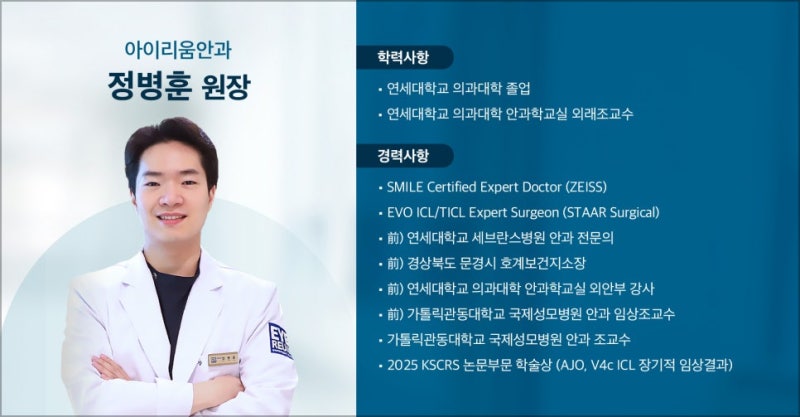

Hello, this is Eyereum Eye Clinic in Gangnam.
Ahead of the Chuseok holiday, many people are looking into SMILE LASIK or planning vision correction surgery using their paid leave and holidays.
A recent medical column published by Dr. Byoung Hoon Jeong of Eyereum Eye Clinic explained why, even with the same 20/20 (1.0) vision after SMILE LASIK, the actual 'quality of vision' experienced can differ.
What is 'quality of vision' in SMILE, and why are higher-order aberrations, laser energy, and surgical design so critically considered?
Let’s break down the contents of ophthalmologist Dr. Byoung Hoon Jeong's medical column in an easy-to-understand way.
[ View Original Article ]
Why can the same 20/20 vision feel so different?
The official medical term for 'SMILE LASIK' is 'SMILE' (Small Incision Lenticule Extraction). As the name suggests, a femtosecond laser creates a refractive lenticule inside the cornea corresponding to the prescription, which is then extracted through a tiny incision to correct myopia and astigmatism.
Unlike conventional LASIK, which creates a corneal flap, SMILE involves a minimal incision and allows for a relatively fast return to daily activities, making it a popular choice for working professionals over weekends or holidays.
However, there is something just as critical to examine as the recovery period: how clearly and comfortably you see after surgery—the 'quality of vision.'
Even if two patients test at 20/20 on a standard eye chart, they may experience noticeable differences in nighttime halos, glare, sharpness, and contrast sensitivity.
What are the higher-order aberrations related to 'quality of vision'?
One of the key topics highlighted in the article is higher-order aberrations (HOAs).
Unlike typical refractive errors like myopia or astigmatism, higher-order aberrations refer to subtle optical distortions that cannot be easily corrected with standard glasses or contact lenses. To use an analogy: even if your eyeglasses have the exact right prescription, minute scratches on the lens surface will keep your vision from being crisp and clear.
Even with 20/20 visual acuity, an increase in higher-order aberrations prevents light from focusing sharply into a single point, leading to nighttime glare, halos, starbursts, and diminished clarity. This is why modern refractive surgery focuses not just on achieving the target visual acuity, but also on how higher-order aberrations change post-operatively.
Why lower the laser energy in SMILE?
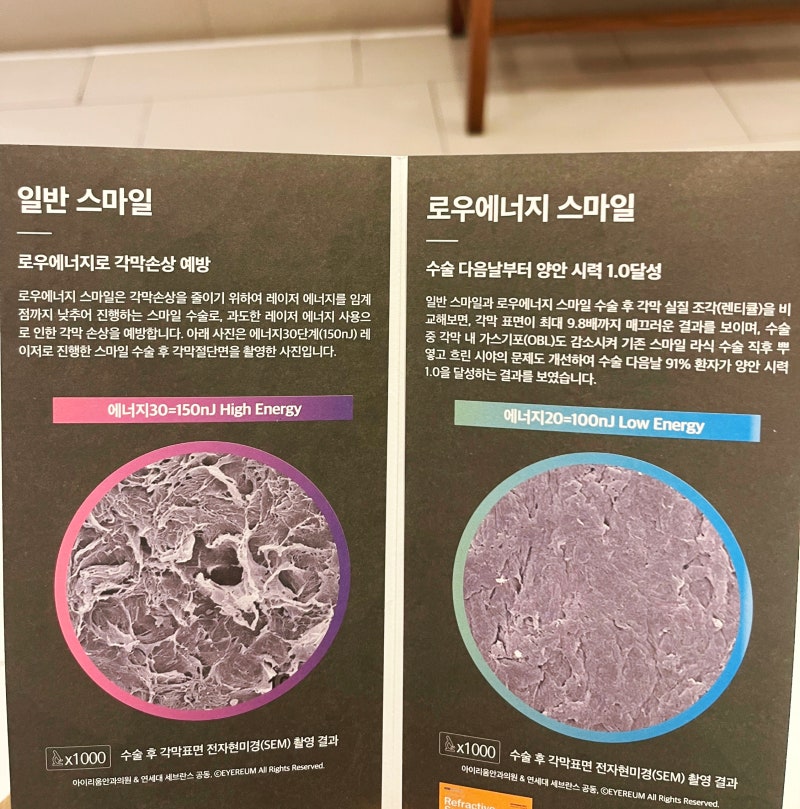
In SMILE surgery, a femtosecond laser is used to form a lenticule within the corneal stroma. The level of laser energy applied can significantly impact the smoothness of the corneal cut surface and the surrounding tissue response.
The medical team at Eyereum Eye Clinic has researched the correlation between laser energy and post-operative visual quality for years, publishing numerous papers in international SCI-indexed journals.
One of the refined techniques developed through this research is Low-Energy SMILE.
The key takeaway is not simply that 'lower energy is always better,' but rather customizing the laser energy and surgical profile to each individual's unique corneal characteristics.
What sets Plasma SMILE apart?
This ongoing research has recently led to the development of Plasma SMILE.
Plasma SMILE integrates plasma-based surgical engineering into SMILE Pro, offering distinct advantages beyond simply reducing laser energy levels.
While maintaining the same total laser energy, it utilizes lower pulse energy combined with asymmetric laser spacing, strategically redesigning the energy distribution and delivery pattern.
This design minimizes microcavitation (tiny gas bubbles generated during lenticule formation) and significantly reduces physical stress on the corneal tissue.
📌 Changes in Visual Acuity and HOAs Confirmed by Research
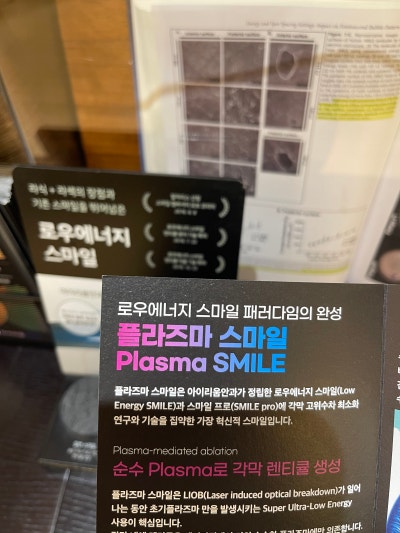
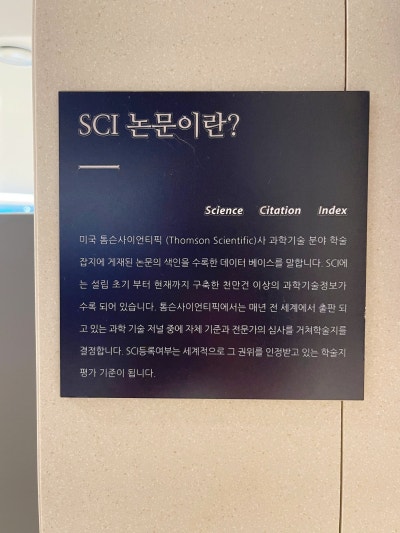
In a study published by the Eyereum surgical team in the SCI-indexed 'Journal of Refractive Surgery,' researchers compared visual acuity and corneal higher-order aberrations following Plasma SMILE.
While uncorrected visual acuity on the first post-operative day showed little difference between groups, the Plasma SMILE group demonstrated a significantly superior visual recovery trend at 2 weeks and 2 months post-op.
Furthermore, the induction of total higher-order aberrations, coma, and spherical aberrations was noticeably lower.
In other words, this study proves that even with the same total laser energy, the way that energy is distributed and delivered critically influences post-surgical visual quality and higher-order aberrations.
[ Learn More About the Plasma SMILE SCI Study ]
When researching SMILE LASIK, pricing, promotions, and the latest equipment are often top considerations.
However, when selecting a surgical procedure, it is vital to comprehensively evaluate the entire ocular condition—including not just myopia, astigmatism, and corneal thickness, but also corneal biomechanics (stiffness), anterior/posterior corneal curvature, and structural symmetry.
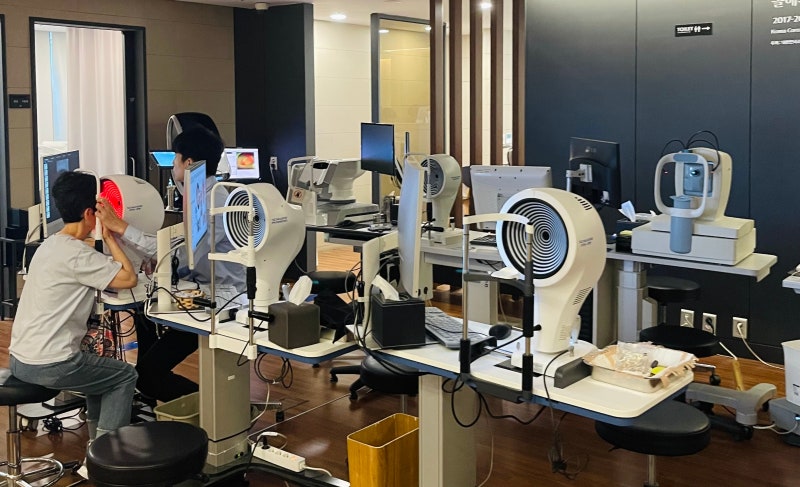
Based on comprehensive diagnostic results, specialists evaluate the most suitable approach among options like standard SMILE, SMILE Pro, Plasma SMILE, or Smart Nova. If SMILE is not optimal for your eyes, alternatives such as 2-Day LASEK or ICL (Implantable Collamer Lens) surgery can be considered.
What matters most is not the brand name of a procedure or laser machine, but choosing a tailored vision correction solution customized to your eyes. If you are planning SMILE LASIK during the upcoming holiday, schedule your precision examination and surgical consultation in advance!
📍 Gangnam SMILE LASIK Clinic
Gangnam Eyereum Eye Clinic is directly connected to Exit 2 of Gangnam Station (Line 2 & Shinbundang Line) without needing to step outside.
Schedule a Precision Exam & Consultation for SMILE LASIK

Book an Examination at Eyereum Eye Clinic

Check SMILE LASIK Pricing & Special September 2026 Benefits

Frequently Asked Questions
Can vision still feel dim or blurry after SMILE even if it tests at 20/20 (1.0)?
Yes, higher-order aberrations can cause vision to feel dim or unclear. Beyond standard nearsightedness or astigmatism, an increase in microscopic optical imperfections (higher-order aberrations) on the cornea can result in nighttime glare, halos, and reduced sharpness or contrast sensitivity despite a 20/20 chart score.
What are the higher-order aberrations that affect visual quality?
They are microscopic optical distortions that cannot be corrected by glasses or standard contact lenses. Similar to tiny surface scratches on an eyeglass lens preventing light from focusing cleanly onto a single point, HOAs cause visual fuzziness. Minimizing HOA induction is therefore a primary focus in modern refractive surgery.
Why is laser energy adjusted during SMILE surgery?
Adjusting laser energy ensures a smoother corneal cut and minimizes surgical trauma to adjacent tissue. Because tissue reaction varies according to femtosecond laser energy levels and delivery patterns, tailoring the optimal energy to each patient's corneal properties is essential for superior results.
How does Plasma SMILE differ from conventional SMILE?
Plasma SMILE utilizes a proprietary laser pulse energy and spacing scheme designed to minimize corneal stress. While preserving the total energy dose, it optimizes delivery to suppress microcavitation bubble formation, significantly lowering post-operative corneal higher-order aberrations and promoting smoother, faster visual recovery.
What precision diagnostic tests are required prior to SMILE surgery?
Along with checking refractive error (myopia/astigmatism) and corneal thickness, comprehensive testing must include corneal biomechanical stiffness and anterior/posterior corneal elevation maps. A complete assessment of corneal durability and symmetry is necessary to determine whether SMILE, LASEK, or ICL is the safest and most effective option for you.