2026-10-26
Can SMILE LASIK Correct Presbyopia in Your 40s? Key Takeaways from Dr. Kang Sung-yong's SNEC Presentation
Dr. Kang Sung-yong of Irium Eye Clinic presented clinical results of combined SMILE and PresbyMAX LASIK for presbyopia in patients in their 40s and 50s at SNEC in Singapore.

Hello, this is Gangnam Eye Clinic, Irium Eye Clinic.
Dr. Kang Sung-yong of Irium Eye Clinic presented clinical results of customized presbyopia correction surgery for patients in their 40s and 50s who have both myopia and presbyopia, at the 'SNEC (Singapore National Eye Centre) 35th Anniversary International Meeting' held in Singapore last July.
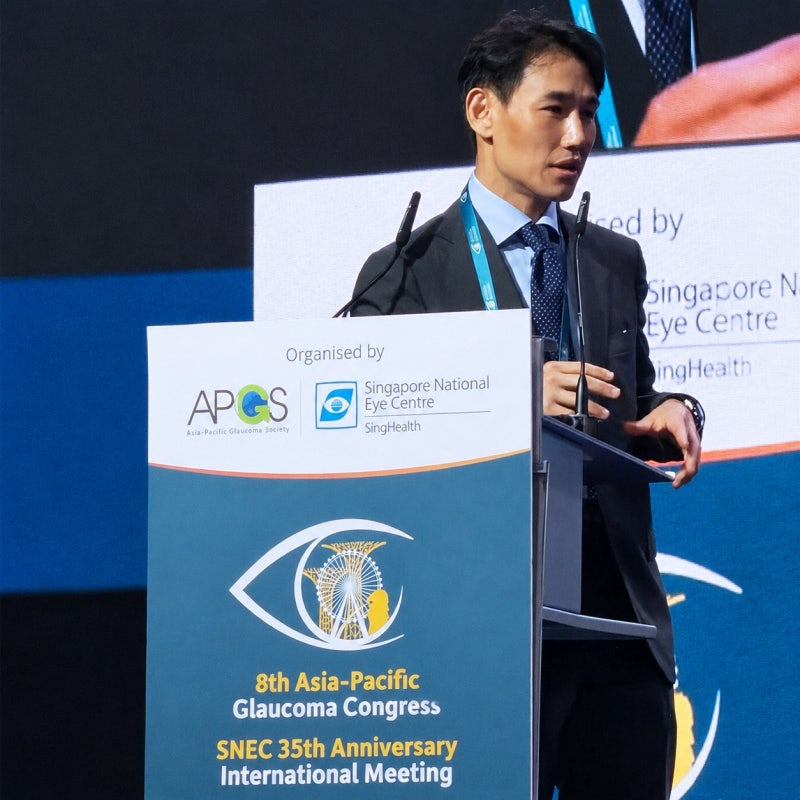
In this presentation, the eye primarily responsible for distance vision was treated with SMILE (KLEx), while the other eye was treated with PresbyMAX LASIK. The talk covered clinical outcomes of this presbyopia surgery as well as a vision correction strategy that also takes future cataract surgery into account.
Dr. Kang Sung-yong presenting clinical results of presbyopia correction surgery for patients in their 40s and 50s at SNEC, Singapore
Key Points from the SNEC International Meeting Presentation
This presentation introduced a customized presbyopia correction strategy that combines SMILE (KLEx) and PresbyMAX LASIK.
The eye primarily responsible for distance vision is treated with KLEx (corneal lenticule extraction procedures such as SMILE and SmartNova) to correct distance vision, while the other eye is treated with PresbyMAX LASIK to improve intermediate and near vision.
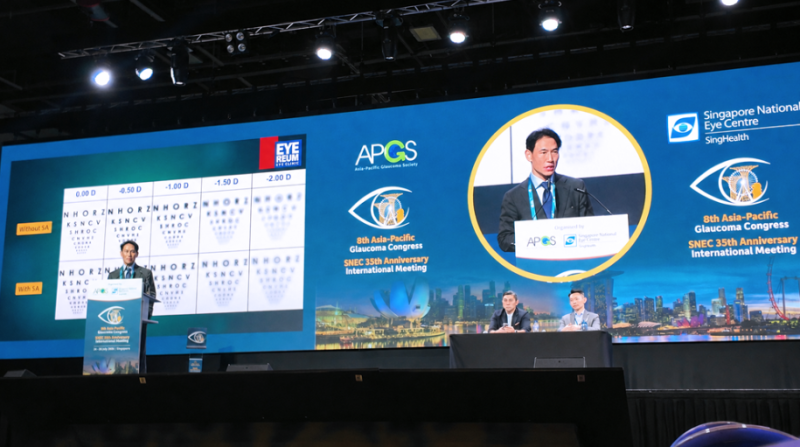
Results from an analysis of 96 patients (192 eyes) with myopic presbyopia, average age 50:
✔ All patients achieved binocular uncorrected distance visual acuity of 20/20 or better.
✔ All patients achieved near vision of J2 or better, enough to read text messages and documents on a phone.
✔ About 82% achieved J1-level near vision, confirming satisfactory visual function from distance to near.
✔ On ocular surface testing, tear film breakup time (TBUT) was longer in the eye treated with KLEx, but patient-reported dry eye symptoms (OSDI) showed no significant difference between the two eyes.
The presentation also highlighted the importance of long-term vision planning that considers not only current presbyopia correction but also intraocular lens (IOL) selection for future cataract surgery.
About presbyopia correction, presbyopia LASIK, vision correction in your 40s and 50s, and PresbyMAX
Let's take a closer look, in simpler terms, at the questions patients ask most often.
Q. Can presbyopia be corrected with SMILE LASIK in your 40s?
Yes, if your eyes are suitable for it.
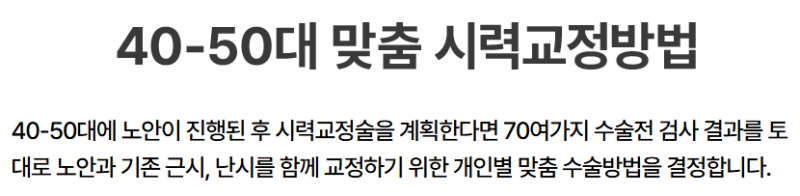

In this study, the eye primarily responsible for distance vision was treated with KLEx (a SMILE-type corneal lenticule extraction procedure) to correct distance vision, while the other eye was treated with PresbyMAX LASIK to cover intermediate and near distances. This customized presbyopia correction strategy was applied.
The key point is that the same approach is not applied to every patient. Surgical plans are tailored to each person based on the degree of presbyopia progression, lifestyle, and eye condition.
Q. What is PresbyMAX?
PresbyMAX is a presbyopia correction procedure that precisely reshapes the cornea to widen the range over which you can see clearly.
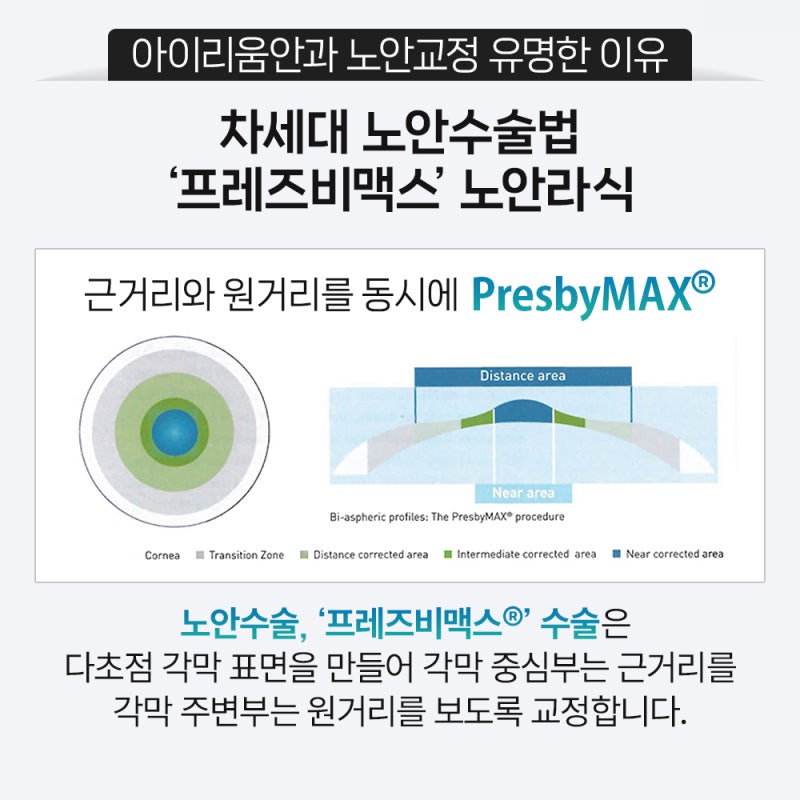
The eye that mainly handles distance vision keeps its distance focus, while PresbyMAX is applied to the other eye so that intermediate and near distances can be seen more comfortably.
Unlike conventional monovision, which creates a large difference in power between the two eyes, this approach balances both eyes to help you see at multiple distances more naturally.
Q. How is it different from conventional monovision presbyopia LASIK?
In conventional monovision, one eye is focused for distance and the other for near, which requires a large difference in power between the two eyes.
In some patients, this can cause discomfort at intermediate distances, dizziness, or reduced depth perception.
By contrast, the biggest difference with PresbyMAX is that it reduces the power difference between the two eyes while widening the focal range, so you can see at multiple distances more naturally.
Q. After presbyopia surgery, will I see as well as I did in my 20s or 30s? Does the result last a lifetime?
Presbyopia is a natural part of aging that continues to progress over time.
Therefore, presbyopia correction surgery is not a treatment that stops aging or restores the lens function of your younger years.

The goal of presbyopia correction surgery is not to return your eyes to how they were in your 20s or 30s, but to reduce your reliance on glasses or reading glasses so you can get through daily life more comfortably.
As time passes, presbyopia may continue to progress, and depending on your eye condition, additional correction or future cataract surgery may be considered.
That said, you may still need reading glasses or magnifiers for prolonged reading of small print or in dim lighting.
Q. Can I still have cataract surgery after PresbyMAX?
Yes, it is possible.
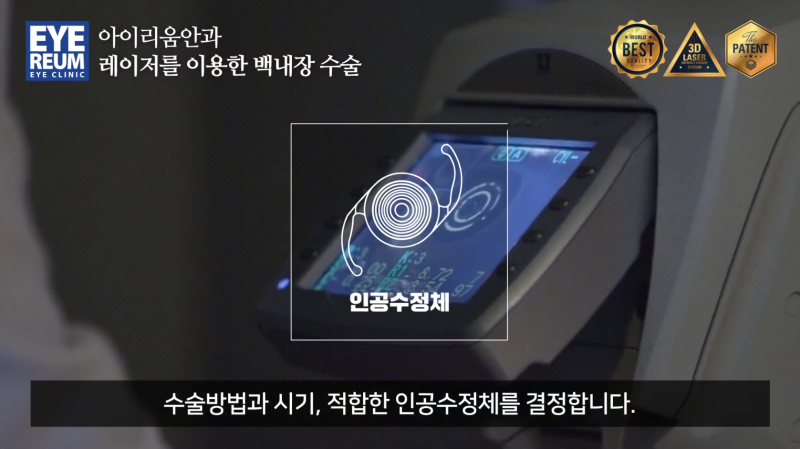
However, cataract surgery requires considering the optical characteristics of the cornea shaped by PresbyMAX, your current eye condition, and the properties of the intraocular lens to be used.
In other words, long-term vision planning that accounts for future cataract surgery, not just current vision improvement, is important.
Q. Is this surgery suitable for everyone?
The same surgical method is not applied to every patient.
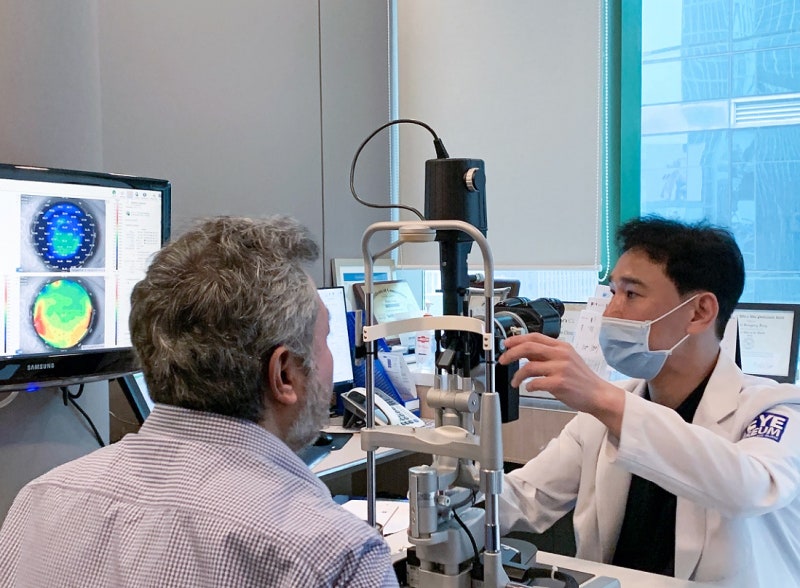
We comprehensively evaluate not only the degree of presbyopia and myopia, but also corneal thickness and rigidity, dry eye, and the presence of cataract or retinal disease, before determining the surgical method best suited to each individual.
For vision correction in your 40s and 50s, it is important to look beyond simply correcting nearsightedness. Consider your current discomfort as well as the future progression of presbyopia and cataracts.
Even within the same age group, presbyopia severity, degree of myopia, corneal condition, and lifestyle all vary, so one procedure is not the right answer for everyone.
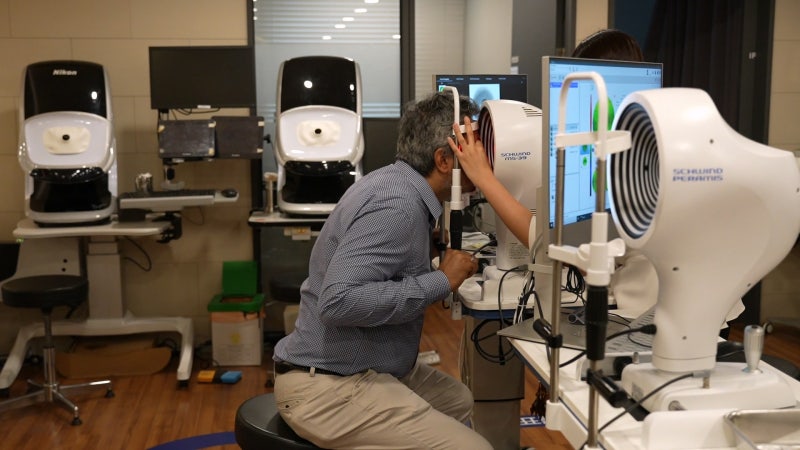
Above all, it is essential to accurately assess your eye condition through thorough testing and choose a surgical method that fits your long-term vision plan.
※ This content is medical information adapted from research presented by Dr. Kang Sung-yong of Irium Eye Clinic at the SNEC 35th Anniversary International Meeting, rewritten to be easy for patients and caregivers to understand. Actual surgical methods and eligibility may vary depending on the results of detailed examinations.
#40sSmileLASIK #40sVisionCorrection #40sLASIK #50sVisionCorrection #50sLASIK #PresbyopiaCorrection #PresbyopiaSurgery #PresbyopiaAndCataract #PresbyMAXLASIK #SmileSurgery #GangnamEyeClinic #IriumEyeClinic #IriumPresbyopia #IriumDrKangSungYong


Frequently Asked Questions
Can I correct presbyopia with SMILE LASIK in my 40s?
Yes, if your eyes are suitable. The presentation introduced an approach in which SMILE (KLEx) is applied to the eye responsible for distance vision and PresbyMAX LASIK to the other eye, with a plan tailored to each person based on the degree of presbyopia progression, lifestyle, and eye condition.
What is PresbyMAX?
PresbyMAX is a presbyopia correction procedure that precisely reshapes the cornea to widen the range over which you can see clearly. Rather than creating a large power difference between the two eyes, it balances both eyes to help you see at multiple distances naturally.
How is it different from conventional monovision presbyopia LASIK?
PresbyMAX reduces the power difference between the two eyes and widens the focal range, so it is designed to let you see at multiple distances more naturally. Conventional monovision creates a large power difference to focus one eye for distance and the other for near, and some patients may experience discomfort at intermediate distances, dizziness, or reduced depth perception.
Can I have cataract surgery after PresbyMAX?
Yes, it is possible. However, cataract surgery requires considering the optical characteristics of the cornea shaped by PresbyMAX, your current eye condition, and the properties of the intraocular lens to be used. Long-term vision planning that accounts for future cataract surgery, not just current vision improvement, is important.
After presbyopia surgery, will I see like I did in my 20s or 30s?
Presbyopia correction surgery does not return the eyes to the state of your 20s or 30s. Presbyopia is a natural aging process that continues to progress, and the goal of the surgery is to reduce reliance on glasses or magnifiers in daily life. Presbyopia may continue to advance over time, and reading glasses or magnifiers may still be needed for prolonged reading of small print or in dim lighting.
Is this surgery suitable for everyone?
The same procedure is not applied to every patient. Before determining the most suitable method, a comprehensive evaluation is carried out, covering the degree of presbyopia and myopia, corneal thickness and rigidity, dry eye, and the presence of cataract or retinal disease. Eligibility may vary depending on the results of detailed examinations.