2026-05-18
Why Mental Care Is Crucial During Post-Surgical Recovery
Dr. J from SNUplastic Surgery discusses why mental care is crucial during post-surgical recovery. Right after surgery, facing swelling, bruising, and temporary asymmetries can increase anxiety—especially for international students or those at major life transitions. This article advises that since body and mind are interconnected, during high-stress periods, focusing on your primary responsibilities and considering non-surgical, reversible treatments may be wiser choices.

SNUplastic Surgery | Post-Surgical Recovery: Why Is 'Mental Care' Essential?
Hello.
I'm Dr. J from SNUplastic Surgery.
A few days ago, I heard some troubling news
from an old acquaintance.
His daughter, who currently studies abroad,
visited Korea during her break and underwent
double eyelid surgery before returning to her studies.
However, due to the asymmetry that developed
as the post-surgical swelling subsided and a slower-than-expected
recovery timeline, she's been struggling
in her local country.
We all know that post-surgical recovery varies
greatly from person to person, and especially with eye surgery,
you need to wait at least 3-6 months
to see the final results.
But why do so many people
struggle emotionally during recovery?
Today, I want to discuss
why 'mental support' is so important during post-surgical recovery,
and more importantly, ask 'Is this surgery really
necessary for me right now?'
Why Mental Health Struggles During Recovery
1. Facing a Stranger in the Mirror
The face you see immediately after surgery
is not your final result.
It's a 'work-in-progress face' accompanied
by severe swelling, bruising, and temporary distortion.
However, our brains struggle to accept such sudden changes.
It's especially difficult for those living alone overseas. With no family to offer familiar comfort and no friends who understand your situation, you face a stranger in the mirror every morning.
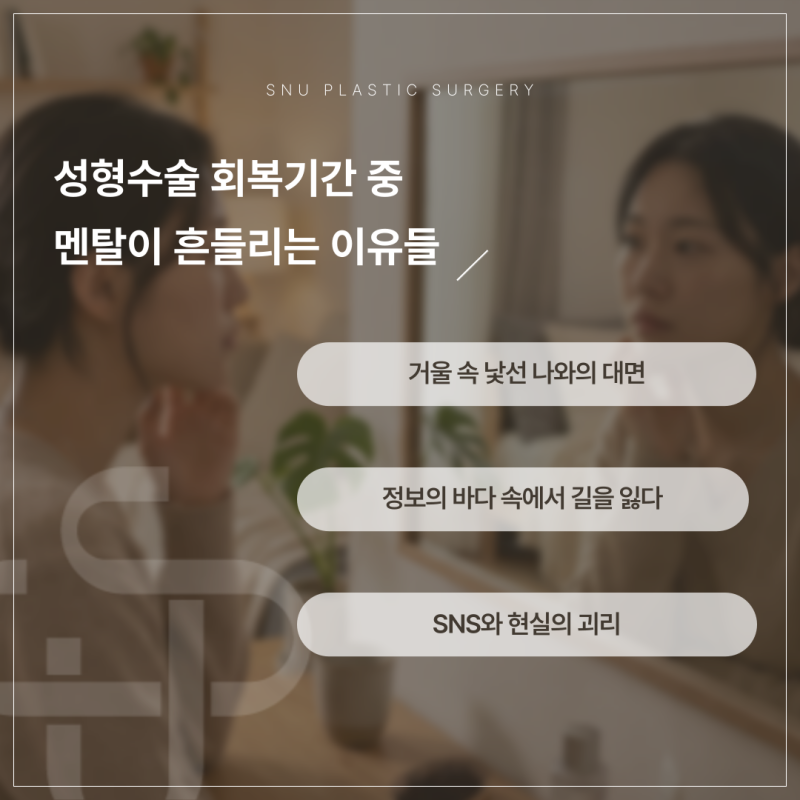
2. Lost in a Sea of Information
The more time you spend alone,
the more you turn to the internet trying to ease your anxiety.
Negative reviews amplify anxiety, and being overseas
makes communication with your surgeon difficult,
leaving you feeling even more helpless.
3. The Gap Between Social Media and Reality
You find yourself comparing your recovery
to the polished recovery photos others share on social media,
leading to self-blame.
When you're alone overseas, this comparison-driven
depression can cut even deeper.
Going Deeper: Asking the Fundamental Question
In reality, our lives are already filled with stress factors.
Divorce, grief, illness, important exams,
studying abroad in unfamiliar places—
all of these can be psychologically vulnerable periods on their own.
So during these 'critical turning points' in life,
is it really necessary to add another source of stress—
cosmetic surgery?
1. Body and Mind Are 'One'
When the body experiences stress,
its healing ability decreases.
Those going through divorce proceedings,
grieving a loss, or facing important exams
are likely to experience slower healing,
even after the same surgery.
Immunity decreases, and inflammatory responses
can be more pronounced.
Moreover, when your mental state is unstable,
it's difficult to make 'rational judgments' about your surgical results.
What would normally be a small asymmetry you'd dismiss
with 'I'm still healing, I'll wait'—
can escalate into extreme thoughts like 'Why is my life such a mess?
The surgery is ruined!'
An already-exhausted mind can't bear the 'final straw'
of post-surgical anxiety.
2. Focusing on Your Primary Responsibilities
Is the Best 'Self-Care'
If you're preparing for a fresh start after divorce,
need to pass an important exam, or have the responsibility
of your studies abroad—
putting all your energy into that 'primary focus'
is the wiser choice.
Cosmetic surgery consumes far more energy than you might think.
There's the energy spent on consultations and decisions,
the physical toll of surgery itself, and months of
'anxiety about results' and 'the hassle of aftercare.'
Redirecting that energy toward exam preparation,
adapting to a new environment, or healing your mind
could be far more productive.
3. 'Non-Surgical & Reversible' Options
Are Wiser Approaches
If you really feel the need to change something right now,
why not consider less demanding non-surgical treatments
before resorting to surgery?
✅ Start with minimal-recovery, minimal-disruption options
like skincare, laser toning, or Botox—
or choose 'reversible' options like fillers that naturally
return to baseline over time.
These methods work because even if you're unhappy
with the results, time will resolve them—
you won't add the weight of an irreversible decision
to your already-stressed life.
4. A Special Message for International Patients
I especially want to address international patients,
students studying in Korea, and foreigners who trust Korea's medical system.
While surgery in Korea is undoubtedly high-quality,
you must consider the reality that post-surgical recovery
happens 'locally (abroad).'
Like the acquaintance's daughter, the loneliness of facing
post-surgical swelling anxiety with no one to share it
or comfort you is greater than you'd expect.
Calling your Korean hospital brings only responses like
'It'll be fine with time,' but having to face visible changes
and anxiety alone is unbearable.
Rather than hastily deciding to 'get surgery during vacation in Korea,'
please carefully consider whether you have a local support system
for ongoing care and consultation, and whether you can handle
the emotional ups and downs that may occur for 2-3 months post-surgery.
What Do I Really Need Right Now: 'Change' or 'Stability'?
Cosmetic surgery isn't a bad choice.
It can be an investment in yourself.
But 'timing' is everything.
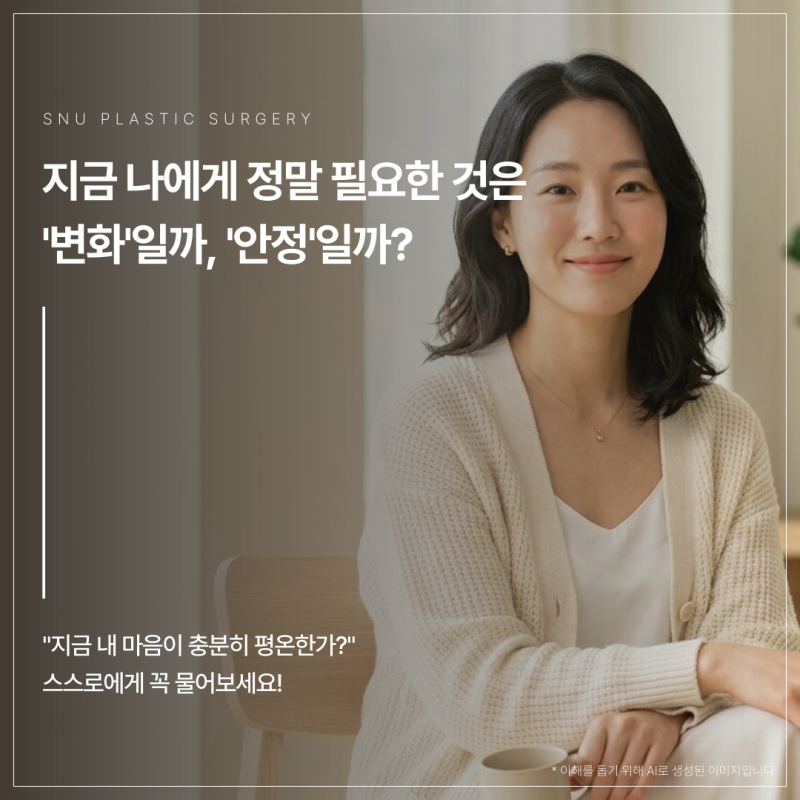
During life's major storms, rather than creating another
change yourself—
✔️ Focus on what you're already doing
(your primary responsibility)
✔️ Endure this present moment well
✔️ And build psychological reserves
for any uncertainties ahead
This might be the more valuable
'self-care' after all.
To everyone considering surgery right now, my message is:
ask yourself this question.
Is my mind at peace right now?
When life is difficult, what you need is often 'small comfort,'
not 'big change.'
What do you think?
If you've ever considered cosmetic surgery or a major decision
during a stressful period, please share your experience in the comments.
Website
📌 KakaoTalk Channel (Click image below)
Frequently Asked Questions
When Can I See My Final Results After Surgery?
For eye surgery, you'll need to wait at least 3-6 months to see your final results. Immediately after surgery, your face is in a 'work-in-progress' state with swelling, bruising, and temporary distortion, making it difficult to judge the final outcome.
Why Do I Feel Emotionally Struggling During Recovery?
It's because of the unfamiliar face in the mirror post-surgery, negative reviews online, and comparing yourself to others on social media. Sudden changes are hard to accept, and the longer you're alone, the deeper anxiety and depression can become.
Is It Safe to Have Surgery in Korea While Studying Abroad?
It's best to think carefully about this. While surgery in Korea is high-quality, your recovery happens locally. Without anyone to consult when swelling changes or asymmetry develops, loneliness and anxiety can intensify significantly.
Should I Have Surgery During Major Life Changes?
It's best to avoid it if possible. During stressful periods like divorce, grief, exams, or studying abroad, your immunity and healing ability decrease, and you're more prone to extreme reactions to minor asymmetries, making rational judgment difficult.
What Are Less Demanding Alternatives to Surgery?
I recommend considering non-surgical, reversible treatments first. Options like skincare, laser toning, and Botox have minimal daily impact, or you could choose reversible methods like fillers that naturally revert over time with far less burden.
How Long Do Emotional Ups and Downs Last After Surgery?
You may experience emotional ups and downs for at least 2-3 months post-surgery. Consider carefully whether you can handle this period alone or if you have support nearby, and decide accordingly.