2026-05-18
Dark Circles and Under-Eye Fat: Is Removal the Only Answer? Under-Eye Fat Repositioning and Nano Fat
Under-eye sagging and dark circles result not simply from protruding fat, but from a complex interplay of lid-cheek junction descent, under-eye fat herniation, and anterior cheek volume loss. Snuplastic offers a surgical approach that repositions fat to the hollowed anterior cheek instead of removing it, and uses nano fat to safely augment the lateral areas where repositioning cannot reach, restoring natural contours.

Dark Circles and Under-Eye Fat: Is Removal the Only Answer?
Hello.
This is Snuplastic.
Today, we'd like to discuss
under-eye fat (eye bags),
a concern many of you share.
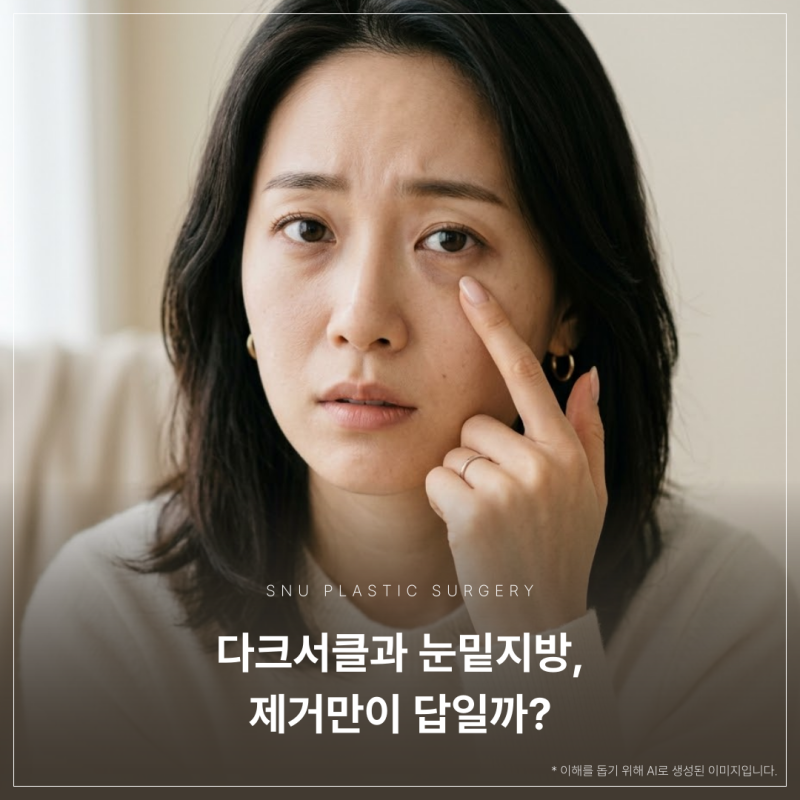
Usually, when people think of under-eye surgery,
they only think about
'removing fat.'
But in recent plastic surgery,
more natural and functional surgical methods
are gaining attention.
The key concept behind this is
the Lid-Cheek Junction.
1. What is the Lid-Cheek Junction?
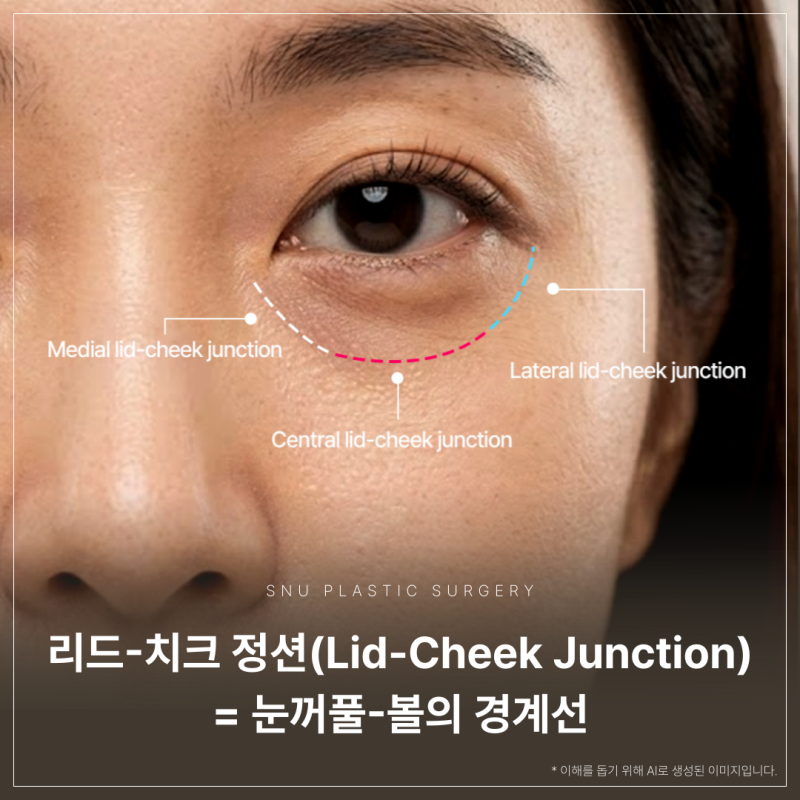
The Lid-Cheek Junction refers to
the 'eyelid-cheek boundary line'
in other words.
In simpler terms, it's the contour line where
the lower eyelid connects to the cheek.
When young, this boundary line is smooth
and positioned high, making the under-eye area
appear firm and voluminous.
But what happens as we age?
✅ Lid-Cheek Junction Descent
As the boundary line itself sags downward,
the under-eye area appears longer
and looks more fatigued.
✅ Under-Eye Fat Herniation
The protective fat under the eye
protrudes forward. (Eye bag formation)
✅ Anterior Cheek Volume Loss
The front part of the cheek becomes hollow,
deepening the shadows.
Ultimately, the "dark circles"
and "under-eye sagging" we dislike
are not simply caused by protruding fat,
but rather result from
these three phenomena working together,
creating a shadowing effect.
2. The Principle of Under-Eye Fat Repositioning—Relocating Fat, Not Discarding It!

This is where the concept of
under-eye fat repositioning comes in.
Rather than unconditionally removing protruding fat,
the idea is to preserve the fat and relocate it
downward to fill the hollowed anterior cheek.
✅ Result 1
As the protruding fat moves downward,
the eye bag naturally flattens.
✅ Result 2
As volume is restored to the hollowed anterior cheek,
the contour of the Lid-Cheek Junction
becomes smooth and refined again.
✅ Result 3
Overall, the under-eye area brightens,
and the face looks younger.
3. But What About the Lateral Area? The Solution: 'Nano Fat'

Even this remarkable repositioning technique has its limitations:
the lateral area (outer cheek, above the cheekbone).
When lowering under-eye fat,
the medial area (near the nose) is close and tissues adhere well,
making it relatively easy to reposition.
But the outer (lateral) area
is too far away to easily reposition fat downward.
Yet the volume in that area is still deficient,
and this is where fat grafting becomes necessary.
Here's the important point:
The lateral under-eye area is very close to eyelid skin,
so injecting standard microfat can easily result in
a palpable bulge or nodules (lumpy texture).
👉 This is where we use
'nano fat.'
4. What is Nano Fat? For Safety and Regeneration, Not Just Volume
Nano fat is fat that has been processed into an even finer,
emulsified state through a mechanical process.
✨ Advantage 1: Safety
Because the particles are extremely fine,
injection is possible even with thin needles,
and the fat disperses evenly across thin skin layers,
minimizing the risk of nodules.
It's the ideal method for sensitive areas like the lateral under-eye region.
✨ Advantage 2: Skin Texture Improvement Over Volume
Compared to standard fat,
nano fat may provide less volumetric effect.
But nano fat's true value lies elsewhere.
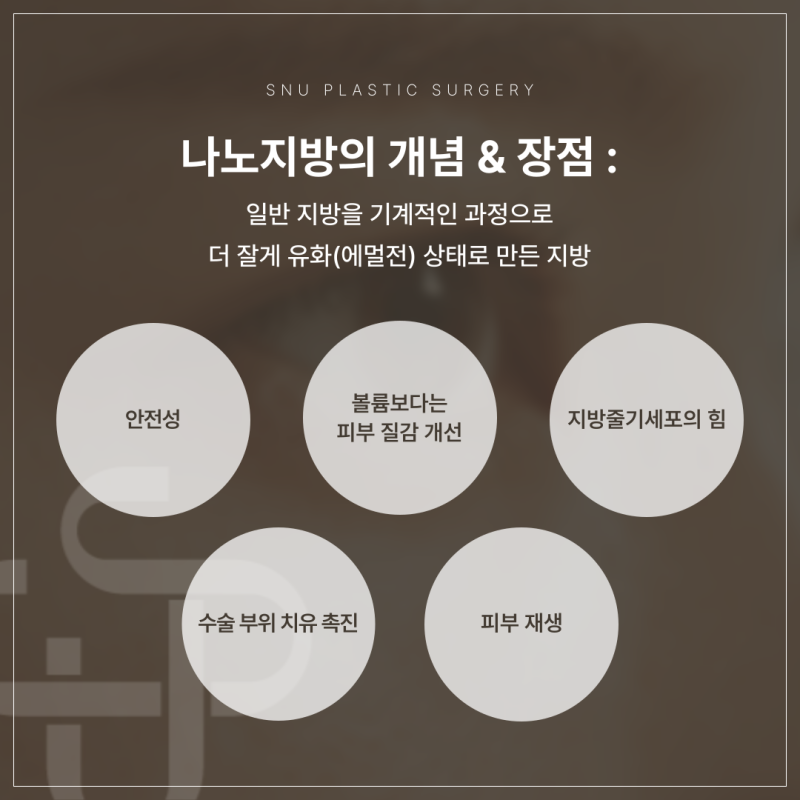
✨ Advantage 3: The Power of Adipose-Derived Stem Cells (ADSCs)
During nano fat processing, fat cells are destroyed,
but adipose-derived stem cells (ADSCs) remain abundant.
When this rich stem cell fraction is injected into the skin,
the following additional effects occur:
👉🏻 Accelerated Surgical Site Healing
Post-operative swelling and bruising resolve quickly,
facilitating recovery.
👉🏻 Skin Regeneration
Skin elasticity increases, fine lines improve,
pores refine, and overall skin quality improves.
Under-Eye Surgery is About 'Contour Restoration,' Not 'Removal'
The real reason the under-eye area looks tired
is because the Lid-Cheek Junction contour has collapsed.
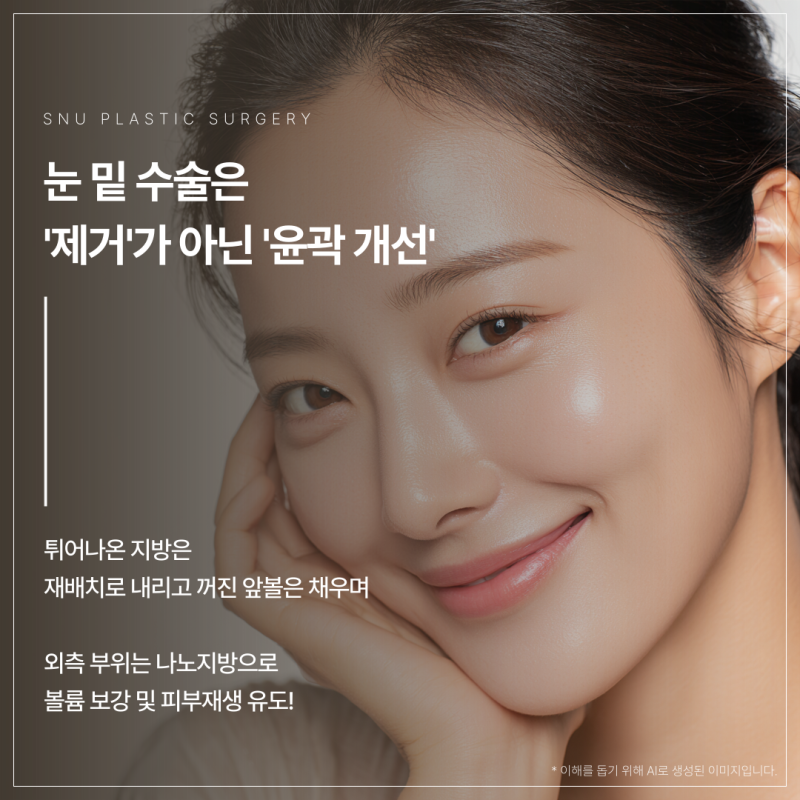
Repositioning lowers the protruding fat,
filling the hollowed anterior cheek,
and safely augmenting the lateral area where
repositioning cannot reach with nano fat,
while simultaneously promoting skin regeneration—
This is the most natural and longest-lasting way
to keep the under-eye area youthful.
We hope you approach your under-eye concerns
not as 'fat trimming,'
but with the mindset of
'contour restoration surgery.' 😊
Please share your questions in the comments!
This article is based on medical facts,
and surgical methods may vary depending on individual conditions,
so a thorough consultation with a specialist is essential.
Website
📌 Kakao Talk Channel (Click the image below to navigate)

Frequently Asked Questions
Do I always need to have my under-eye fat removed?
No, removal is not the only answer. Recently, 'under-eye fat repositioning'—where protruding fat is not removed but relocated downward to fill the hollowed anterior cheek—has gained attention. This approach can flatten the eye bag while simultaneously restoring anterior cheek volume.
What is the Lid-Cheek Junction?
The Lid-Cheek Junction refers to the 'eyelid-cheek boundary line.' It's the contour line where the lower eyelid connects to the cheek. When young, it's smooth and positioned high, but as we age, it sags downward, making the under-eye area appear longer and more fatigued.
What is the real cause of dark circles?
It's not simply caused by protruding fat, but results from three factors working together. The descent of the Lid-Cheek Junction, under-eye fat herniation (eye bag formation), and anterior cheek volume loss all occur simultaneously, deepening shadows and creating the appearance of dark circles and under-eye sagging.
How is nano fat different from standard fat grafting?
Nano fat is standard fat processed into an even finer, emulsified state through mechanical processing. Its ultra-fine particles disperse evenly across thin skin layers and carry minimal nodule risk, making it ideal for sensitive areas like the lateral under-eye region close to eyelid skin.
What are the effects of nano fat?
Its strength lies in safety and skin regeneration rather than volumetric effects. Although fat cells are destroyed, adipose-derived stem cells (ADSCs) remain abundant, providing accelerated healing, faster reduction of post-operative swelling and bruising, increased skin elasticity, and improved fine lines and pore refinement.
How do you handle areas where fat repositioning cannot reach?
The lateral area (outer cheek, above the cheekbone) is reinforced with nano fat. Because this area is too far to effectively reposition fat downward, the hollowed volume is safely filled with nano fat injection while simultaneously promoting skin regeneration effects.