2026-05-18
Can Lower Eyelid Fat Repositioning Improve Dark Circles? A Complete Guide to Effects and Limitations
Lower eyelid fat repositioning is a surgery that relocates protruding fat to hollow areas, creating a smooth under-eye contour. It's highly effective for dark circles caused by shadows and volume issues, but pigmentation, visible vessels, or skin laxity may require different treatments. Here's a realistic breakdown including how it differs from lower blepharoplasty and recovery time.

#LowerEyelidFatRepositioning #LowerBlepharoplasty #UnderEyeFat #DarkCircles #DarkCircleImprovement #UnderEyeSurgery #UnderEyeClinic #PlasticSurgeryConsultation #MiddleAgedEyeSurgery #UnderEyeFatRemoval #FatRepositioning #UnderEyePlasticSurgery #YouthfulSurgery #GangnamPlasticSurgery #GangnamStationPlasticSurgery #WeAverPlasticSurgery
Hello~
Your beauty universe! This is WeAver Plastic Surgery :)👀🧑⚕️
Some people often hear from those around them that they look tired,
even when their under-eye area looks dark or
they're actually feeling great.
The cause is usually not a simple skin issue
but rather a structural problem with under-eye fat.
In these cases, lower eyelid fat repositioning is the surgery most often considered.
However, many people commonly ask the same questions during consultations.
"Will under-eye fat surgery really make my dark circles disappear?"
"How much will my appearance change after surgery?"
Today, we'll realistically break down the actual effects of lower eyelid fat repositioning
and the cases where satisfaction tends to be highest.
✅ What is lower eyelid fat repositioning?
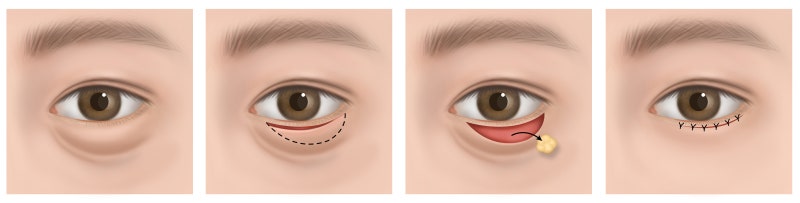
Lower eyelid fat repositioning isn't simply a surgery to remove fat.
It's a procedure that relocates protruding fat under the eyes
to hollow areas, creating a smooth under-eye contour.
Simply put,
it's a surgery that naturally smooths out
an uneven under-eye area.
That's why when the cause of dark circles isn't 'pigmentation'
but rather a 'shadow + volume issue,' lower eyelid fat repositioning is highly effective.
✅ Cases where lower eyelid fat surgery is most effective
Lower eyelid fat repositioning tends to have high satisfaction in the following cases.
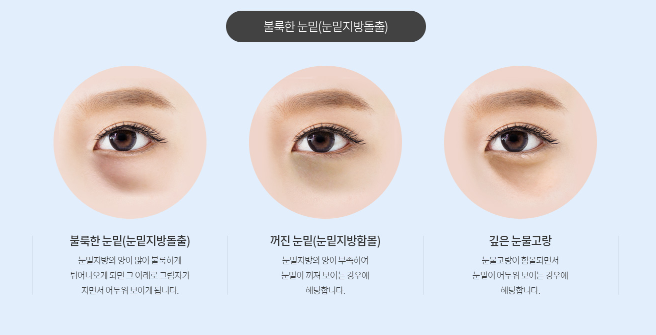
✔️ Protruding under-eye area (under-eye fat protrusion)
✔️ Hollow under-eye area (under-eye fat depression)
✔️ Deep tear troughs
In these cases, after surgery,
the under-eye area becomes smooth and the overall appearance looks much brighter.
✅ Will lower eyelid fat repositioning completely resolve dark circles?
This is a common misconception,
but lower eyelid fat repositioning is not a surgery that solves all dark circles.
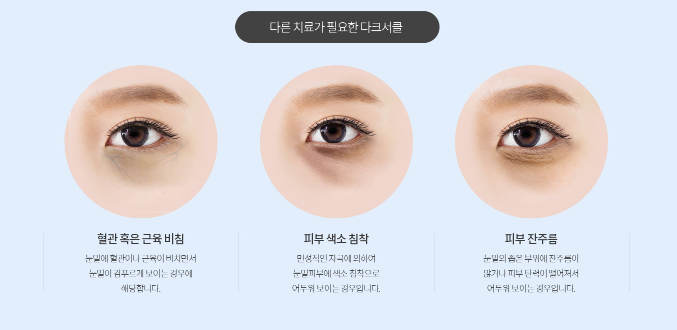
There are dark circles that require different treatments, including
✔️ Cases where blood vessels or muscles show through
✔️ Cases where skin pigmentation makes the under-eye skin look dark
✔️ Cases where fine wrinkles or reduced skin elasticity create a darker appearance
In other words, while it's highly effective for structural issues,
problems with the skin color itself may require different treatments.
✅ Under-eye fat surgery vs. lower blepharoplasty — what's the difference?
The surgery most often compared during consultations is lower blepharoplasty.
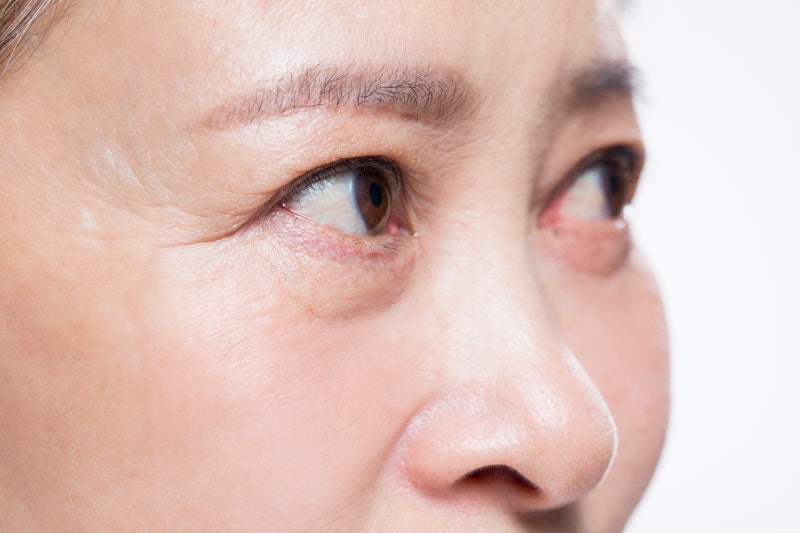
👉 Lower Eyelid Fat Repositioning: Focuses on fat structure / Relatively younger under-eyes / Almost no scarring 👉 Lower Blepharoplasty: Addresses sagging skin + wrinkles + fat / Middle-aged and older / Incisional surgery
If lower eyelid fat repositioning is about "volume contouring,"
lower blepharoplasty is closer to "comprehensive improvement of age-related sagging structures."
※ For severe skin laxity, lower blepharoplasty may be more suitable.
✅ Lower eyelid fat repositioning surgical method
It's mainly performed when the skin hasn't stretched, but tear trough lines are visible
and the area below the protruding fat appears hollow.
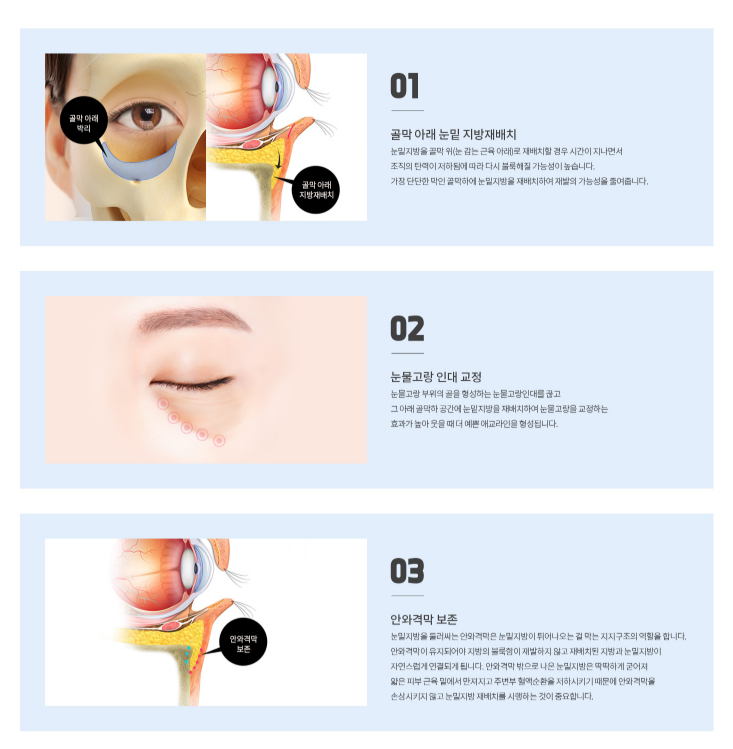
The recovery period is short and swelling is minimal,
so it can be performed even when there isn't enough fat on the inner under-eye area.
When the under-eye hollowing isn't severe,
fat repositioning alone can resolve the issue.
However, when the under-eye hollowing is severe or the area is wide,
additional micro-fat grafting may be necessary.
✅ Most frequently asked questions after surgery

1. How long does recovery take?
Bruising and swelling usually subside naturally within 1–2 weeks.
2. Is it very noticeable?
When the procedure is done through the inner conjunctiva, scarring is barely visible.
3. Can it come back?
While there are differences based on individual anatomy,
changes due to "the natural aging process" are more common than actual recurrence.
Lower eyelid fat repositioning isn't simply a surgery to eliminate the under-eye area.
It's a surgery that structurally improves a tired-looking appearance.
However, since the effect varies greatly depending on the cause of the dark circles,
accurate diagnosis is most important.
During consultation,
distinguishing between fat issues / skin issues / sagging issues
is the key.
👉 View lower eyelid fat repositioning consultation & actual before-and-after cases



Frequently Asked Questions
What is lower eyelid fat repositioning?
It's a surgery that relocates protruding fat under the eyes to hollow areas, creating a smooth under-eye contour. Rather than simply removing fat, it naturally smooths out an uneven under-eye area.
Will lower eyelid fat repositioning completely eliminate dark circles?
Not all dark circles can be resolved. It's highly effective for structural dark circles caused by shadows and volume issues, but cases caused by pigmentation, visible blood vessels or muscles, or reduced skin elasticity may require different treatments.
In which cases is satisfaction highest?
Satisfaction tends to be highest in cases of under-eye fat protrusion (bulging under-eyes), under-eye fat depression (hollow under-eyes), and deep tear troughs. After surgery, the under-eye area becomes smooth, brightening the overall appearance.
What's the difference between lower eyelid fat repositioning and lower blepharoplasty?
Lower eyelid fat repositioning is a volume-contouring surgery focused on fat structure, suitable for relatively younger under-eyes with minimal scarring. Lower blepharoplasty is an incisional surgery that addresses sagging skin, wrinkles, and fat together, making it more suitable for middle-aged and older patients or those with severe skin laxity.
How long is the recovery period after surgery?
Bruising and swelling usually subside naturally within 1–2 weeks. When performed through the inner conjunctiva, scarring is barely visible, and the recovery period is relatively short with minimal swelling.
Can it recur after surgery?
While individual anatomy creates differences, changes due to the natural aging process are more common than actual recurrence. When the under-eye hollowing is severe or the area is wide, additional micro-fat grafting may be necessary.