2026-05-18
Nano Fat vs. Micro Fat: Complete Guide | Must-See for Fat Grafting Decisions
Dr. J from Cheongdam Snuplastic Surgery explains stem cell fat grafting and the practical differences between nano and micro fat techniques. This comprehensive guide covers chemical vs. physical extraction methods, application sites, cost breakdown, anesthesia options, survival rates, site-specific techniques for eyes and lips, filler alternatives, and timing for additional procedures—all addressed through common Q&A questions.

Nano Fat vs. Micro Fat: Complete Guide | Must-See for Fat Grafting Decisions. The Reality of Stem Cell Fat Grafting (feat. Cost, Anesthesia, Survival Rate Q&A)
Hello.
This is Dr. J from Cheongdam Snuplastic Surgery.
These days when I consult on fat grafting,
"Is stem cell fat grafting also possible?"
I receive this question very frequently.
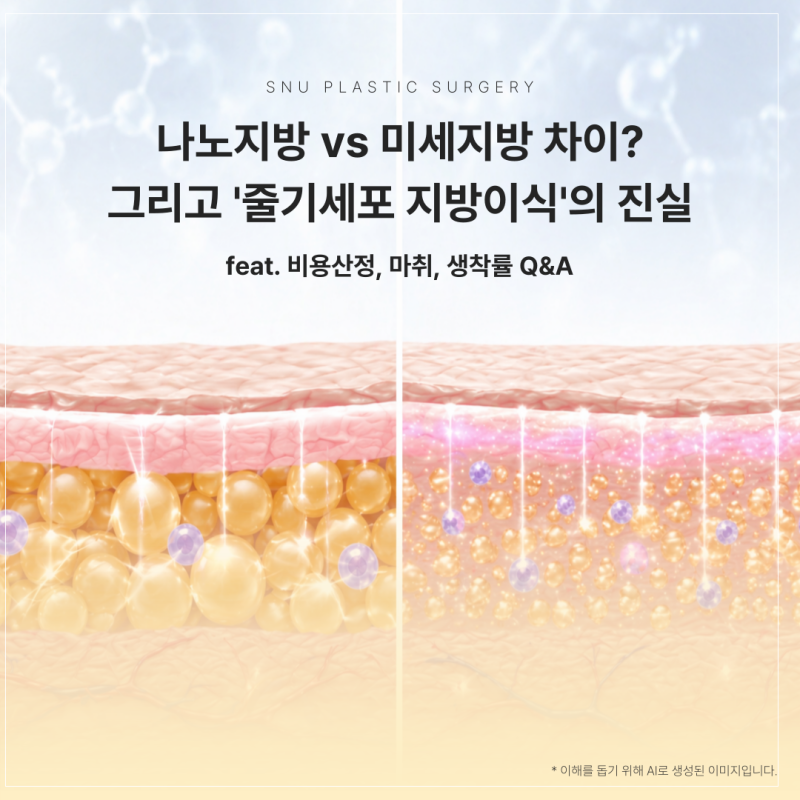
Especially those concerned with under-eye hollowness, forehead, or cheek volume
are naturally sensitive to the term 'stem cells.'
Today, I want to explain how the concept of 'stem cell fat grafting'
is applied in real clinical medicine,
and address frequently asked questions
in our Snuplastic Surgery clinic in Q&A format😊
Part 1. Realistic Approach to Stem Cell Fat Grafting
There's a common misconception
among many people.
'Cultivating stem cells separately
and mixing them with fat before injection.'
To be direct,
this is practically impossible
in clinical practice and is not an approved method.
Cultivation requires
several weeks of time, enormous costs,
and strict GMP facilities.
So, what is the realistic approach?
It's about how well we filter out
the 'Adipose-Derived Stem Cells (ADSC)'
that already exist abundantly in our body's fatty tissue.
While stem cells exist in trace amounts in blood (such as PRP),
without special stimuli like CSF (Colony-Stimulating Factor),
their quantity is minimal, making systemic effects difficult to expect.
On the other hand, fatty tissue is a place with very high stem cell density,
comparable to bone marrow.
Two paths diverge here.
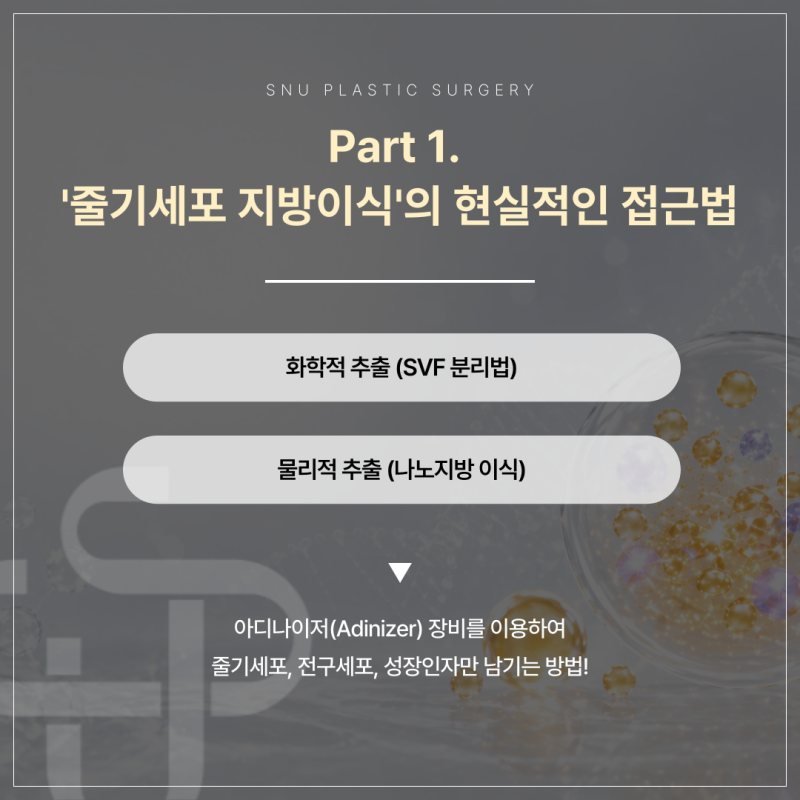
1. Chemical Extraction (SVF Separation Method)
A method using enzymes like collagenase
to dissolve fatty tissue and separate
only the stem cell fraction (SVF).
While theoretically the purity is high,
even with perfect rinsing of chemicals
used in the human body,
there's concern about 'residual substances.'
Since organizations like the FDA
do not officially approve this method,
I do not recommend it from the perspective of
safety and convenience.
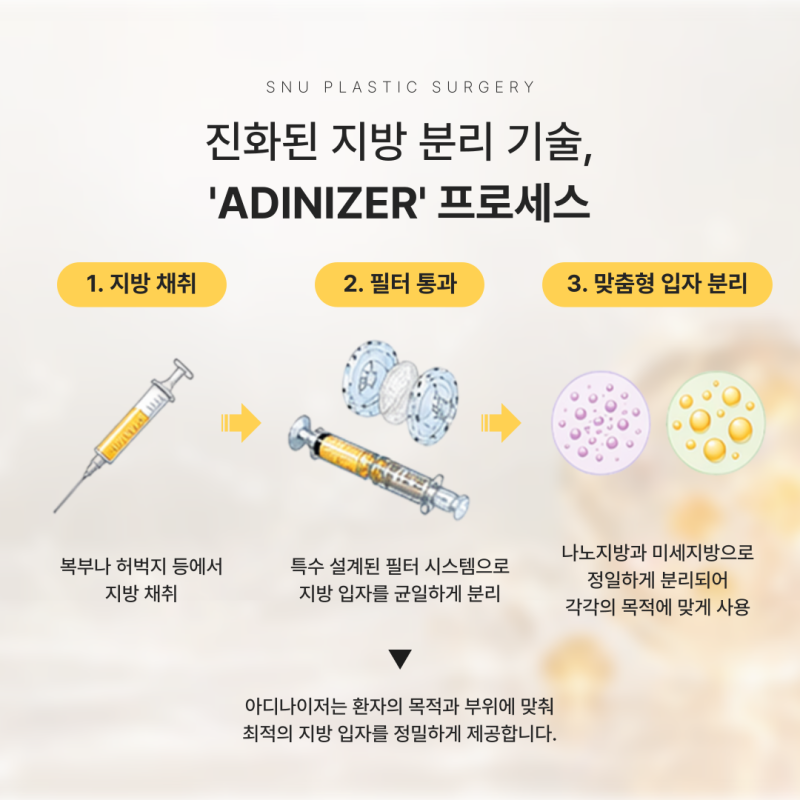
2. Physical Extraction (Nano Fat Grafting)
This is my preferred method.
Using a special filter/mesh device called Adinizer,
large and soft 'mature adipose cells'
are physically destroyed, while
smaller and stronger stem cells, progenitor cells,
and growth factors remain.
This procedure uses no chemical agents,
making it relatively safe and
simple in procedure.
📌 Important Point!
The nano fat created this way is
concentrated with stem cells, but
the number is not overwhelmingly large compared to cultured cells,
and there are many other by-products, so
it cannot be used for intravenous injection (systemic injection).
However, when directly injected into localized areas (under eyes/nasolabial folds/forehead, etc.),
it can improve the microenvironment and
increase survival rate.

📍 Conclusion
I believe that using micro fat (Microfat)
where volume is needed
and nano fat (Nanofat)
where skin regeneration and fine wrinkle improvement are needed
is a reasonable and safe approach.
Part 2. Q&A on Nano/Micro Fat Grafting
Now I'll provide detailed answers to
commonly asked questions in the consultation room.
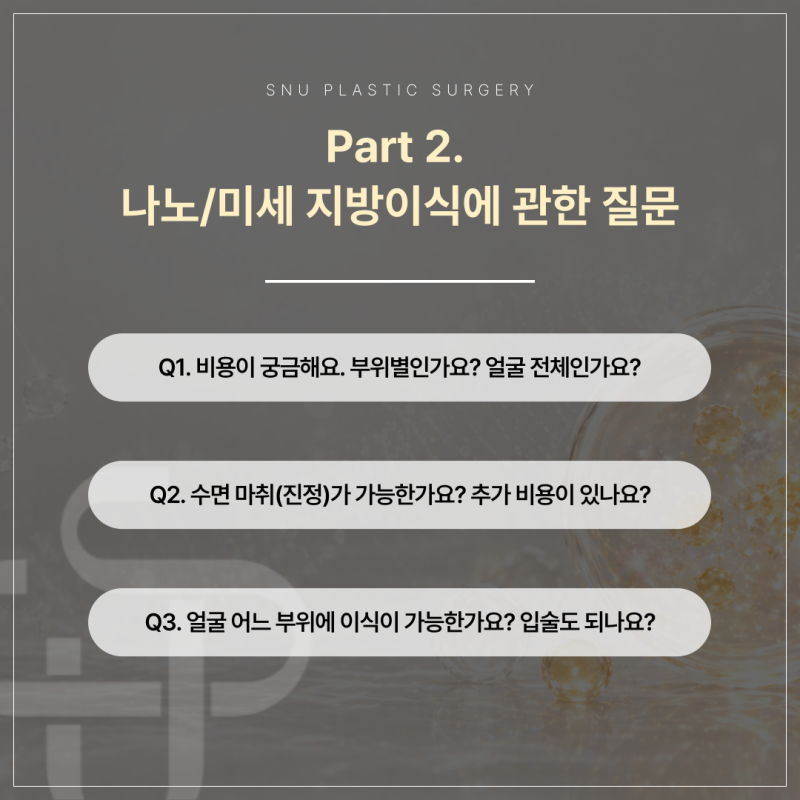
Q1. I'm curious about costs. Is it per area? Or for the entire face?
A. Nano fat is
priced per treatment area.
Face (1 area), neck (1 area), scalp (1 area)
are divided accordingly.
If you undergo both facial and neck treatment simultaneously,
we can share the sterile disposable instruments used,
so we apply a partial discount for additional areas.
On the other hand, micro fat, whose primary purpose is volume enhancement,
is mostly used for overall facial contours such as forehead, temples (side cheeks), and anterior cheeks,
so the cost is determined through separate consultation.
Q2. Is sleep anesthesia (sedation) available? Is there an additional cost?
A. Yes, it is available.
Since fat harvesting is included in the procedure,
I recommend sleep anesthesia (sedation therapy) with an anesthesiologist specialist
to reduce patient anxiety and pain.
With a specialist monitoring breathing and blood pressure,
you can receive the procedure safely and comfortably.
Q3. Which facial areas are suitable for grafting? Can lips be done as well?
A. The most commonly treated areas are
cheeks, temples, and forehead, in that order.
With lips, the fat absorption rate is high.
If you think 'I'll put in more since it will be absorbed anyway' and over-inject,
it actually becomes an unnatural 'overcorrection' that's difficult to reverse.
So many plastic surgeons recommend filler for the lips instead.
This is because fillers have good reproducibility and can be dissolved if unsatisfactory.
However, for those who say "I don't want filler and I'll accept absorption,"
we can achieve a natural appearance without overcorrection.
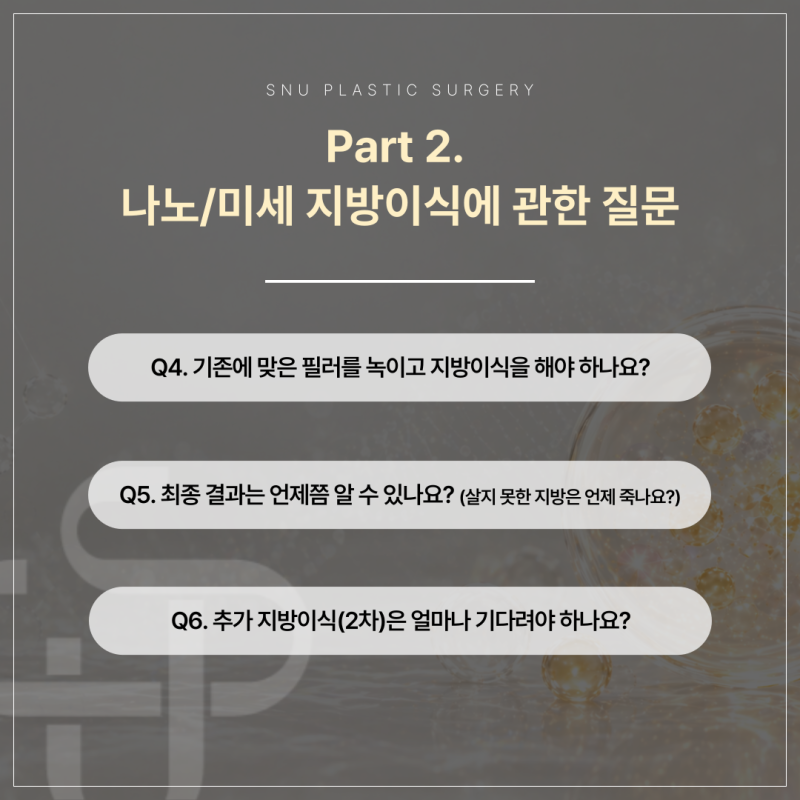
Q4. Should I dissolve existing filler before fat grafting?
A. It depends on the case.
Fat doesn't survive 100%.
And filler (hyaluronic acid) naturally breaks down in the body over time.
While filler can somewhat interfere with fat survival,
if you don't wish to dissolve it, we usually proceed without dissolving it in most cases.
However, this applies only to 'hyaluronic acid filler.'
Permanent fillers or fillers of other compositions must be decided after consultation.
Q5. When can I see the final result? (When does the ungrafted fat die?)
A. The first month is critical for
the survival of grafted fat.
Usually around 3 months in,
the outline of the result becomes fairly clear.
Here's an interesting fact:
rather than fat cells completely dying and being absorbed,
cell size decreases depending on the environment.
After the procedure, if you diet heavily,
the size of grafted fat cells also decreases together,
resulting in reduced volume.
At our hospital, we use the Adinizer to remove fibrous tissue
and inject only pure fat, so
usually 20~30% is lost and
the remaining approximately 70%
settles in as part of the tissue
and is maintained for a long time.
The survival rate is quite good.
Q6. How long do I need to wait for additional fat grafting (second procedure)?
A. Additional grafting to fill deficient areas
is possible at least 3 months later.
This is when the swelling from the first surgery has completely subsided
and the results are clear.
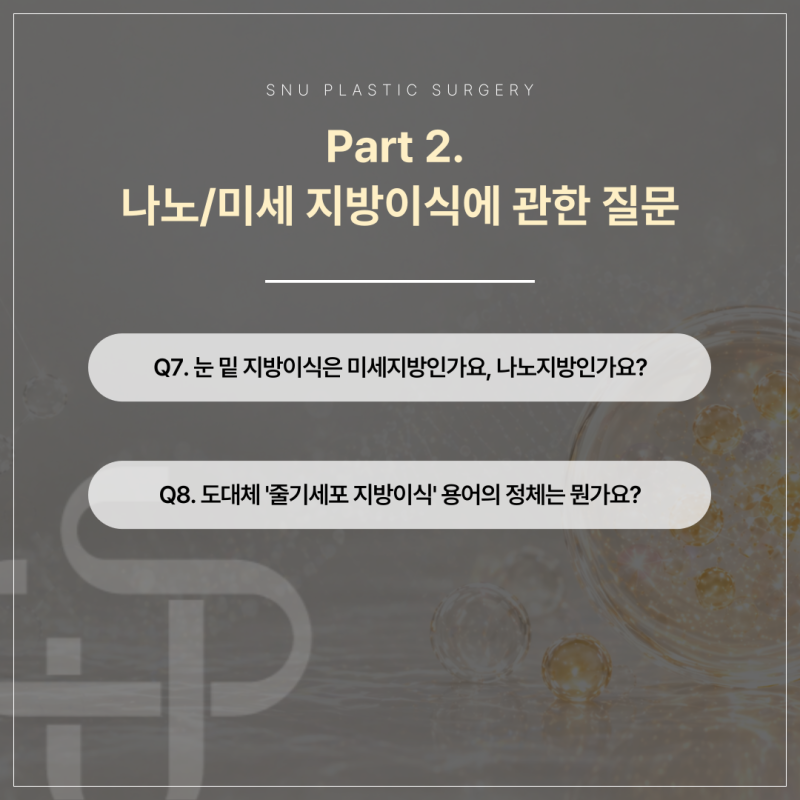
Q7. For under-eye fat grafting, is it micro fat or nano fat?
A. Under-eye skin is very thin, so if fat becomes lumpy,
there's a risk of becoming uneven.
So for the entire under-eye area, we use fine-particle nano fat (Nanofat)
and apply it thinly, as if spreading it.
For areas like the lower eyelid outer edge
(actually the malar/cheekbone area) that require
some volume, we mix in some micro fat (Microfat)
for use.
Q8. What exactly is the 'stem cell fat grafting' terminology?
A. This is the core of what I explained in Part 1.
Stem cells are already included in
micro fat itself.
'Stem cell fat grafting' as a marketing term mostly means
adding SVF (Stromal Vascular Fraction), or
like our hospital, using nano fat together.
I believe nano fat, created on-the-spot through only physical filtering
from the same fat, is safer and more effective
than the cumbersome and controversial SVF separation.
Nano fat is tissue fluid where mature fat cells are destroyed
and only stem cells remain, and it itself already
serves as a stem cell therapeutic agent.
Today's Summary:
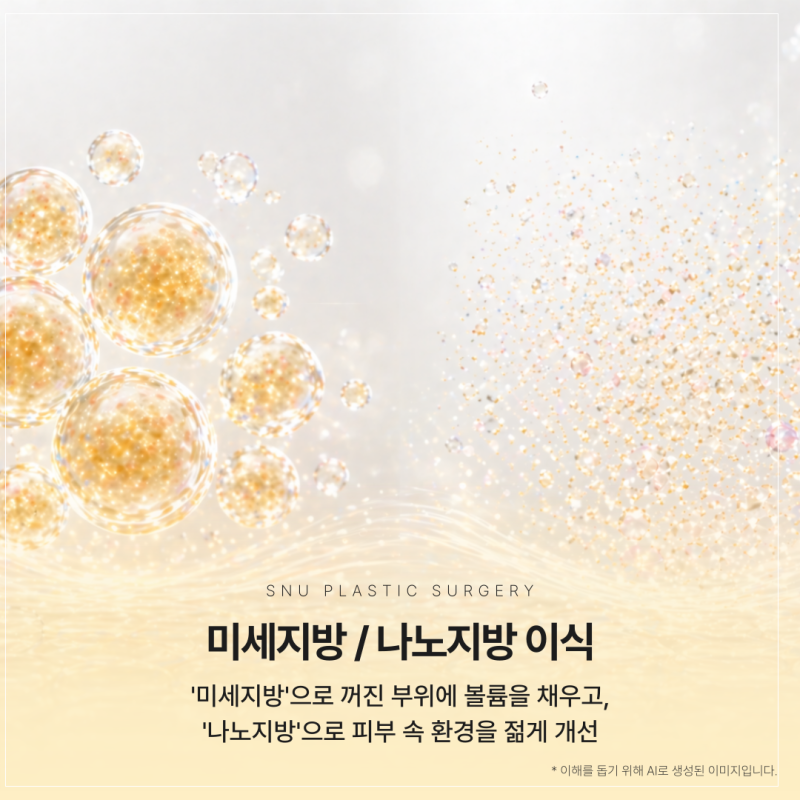
Fat grafting is not simply a procedure that 'fills in oil clumps.'
It's a procedure that complements volume in hollowed areas with 'micro fat'
and aids skin regeneration within the skin with 'nano fat.'
Without chemical agents, through a filtering process.
If you desire both volume and skin regeneration,
please feel free to visit for consultation anytime😊
I will provide accurate diagnosis along with
realistic advice.
Homepage
📌 Kakao Talk Channel (Click the image below to navigate)



Frequently Asked Questions
What is the difference between nano fat and micro fat?
Micro fat (Microfat) is used in areas needing volume, while nano fat (Nanofat) is a form where mature fat cells are destroyed and only stem cells and growth factors remain, utilized for skin regeneration and fine wrinkle improvement. Using both together is a rational approach.
Is stem cell fat grafting actually possible?
Cultivating and mixing stem cells separately is practically impossible in clinical practice due to time, cost, and GMP facility issues, and is not an approved method. The realistic approach is to filter out adipose-derived stem cells (ADSC) from fatty tissue and utilize them.
How is fat grafting cost calculated?
Nano fat is priced per treatment area such as face, neck, and scalp, and if two areas are done simultaneously, sterile disposable instruments can be shared, so partial discounts apply. Micro fat is used for overall facial contours and is determined through separate consultation.
Is sleep anesthesia available for fat grafting?
Yes, it is available. Since fat harvesting is included, we recommend sleep anesthesia (sedation therapy) with an anesthesiologist specialist to reduce patient anxiety and pain. Breathing and blood pressure are monitored for safe and comfortable procedure.
What are the fat graft survival rate and timeline for final results?
The first month is critical, and results typically become clear around 3 months. Using the Adinizer to remove fibrous tissue and inject only pure fat, approximately 20~30% is typically lost while the remaining 70% or so settles in tissue and is maintained long-term, providing a good survival rate.
Is nano fat or micro fat used for under-eye grafting?
Under-eye skin is very thin and risks becoming uneven if fat becomes lumpy, so fine-particle nano fat is used for the entire under-eye area and applied thinly. For areas like the lower eyelid outer edge that require some volume, micro fat is partially mixed in.